In which I argue, against the grain of internet consensus, that the Freight Equalisation Policy is the wrong villain — that the real damage to eastern India was inflicted by Partition, by political turmoil, by the License Raj, and by the long, slow agglomeration logic of capitalism itself; and that if you remove FEP from the story you are left with most of the same outcome.
TL;DR
The standard Indian internet story about the Freight Equalisation Policy (FEP) goes like this: in 1952, Nehru introduced a policy that subsidised the long-distance transport of coal, iron ore, and steel; this neutralised the natural advantage of mineral-rich eastern states (Bihar, West Bengal, Odisha, Madhya Pradesh); industries fled to coastal Maharashtra and Gujarat; the east never recovered; the policy was repealed in 1991–93; the damage is permanent; this is why Bengal is poor and Bihar is poorer.
Almost every clause of that story is partially wrong. Some are entirely wrong. Here is what the data actually shows:
- FEP for iron and steel began in 1956, not 1952. And — critically — coal was never formally under FEP. Coal had uniform pit-head pricing under a different regulatory regime (the Colliery Control Order, 1945), but coal transport was always priced by distance.
- The cash size of the subsidy was small — most credible estimates put it at well under 0.1% of GDP per year at peak. The 1977 Inter-Ministerial Group commissioned by the Planning Commission concluded the subsidies were a “small fraction of firms’ final output prices” and could not have, by themselves, driven the geography of production. The best academic estimates suggest a cumulative real value over the entire 35-year run of perhaps ₹50,000–1,50,000 crore in 2024 rupees — a non-trivial number, but small compared to the magnitudes typically invoked.
- The “subsidy” wasn’t paid by any state. It was a cross-subsidy: short-haul shippers paid above-cost into an Equalisation Fund and long-haul shippers drew from it. There was no central tax transfer, no inter-state fiscal flow. No state’s exchequer “funded” any other state’s industrial growth in cash terms.
- The empirical effects of FEP took roughly three decades to fully appear. The most rigorous econometric study available — Firth and Liu (2018) — finds that FEP gave iron-and-steel-using industries in distant states a roughly 0.5 percentage point annual growth advantage, and that this effect built up gradually from negligible in the late 1950s to its full magnitude only by 1990. Bengal began declining before FEP’s effects were visible in the data.
- West Bengal’s collapse was multi-causal. Academic consensus identifies at least five overlapping causes: nation-wide recessions, the Partition shock to the jute belt, the License Raj’s asymmetric treatment of WB versus Maharashtra, capital flight driven by Naxalite violence and militant trade unionism, and FEP. Removing FEP from this list would still leave a state in serious trouble.
- Punjab and Maharashtra “benefited from FEP” is largely a myth. Maharashtra was already India’s #2 economy in 1960-61, before FEP had time to bite — its lead came from pre-existing Bombay agglomeration, not from subsidised steel freight. Punjab’s gain was the Green Revolution in agriculture; its industrial share plateaued through the entire FEP era and has fallen since. The actual industrial winners of the FEP era are more accurately described as “the agglomeration that already existed in Bombay, Delhi-Punjab industrial belt, and the Madras presidency.”
- The repeal of FEP was empirically symmetric. When the policy was lifted in 1992, iron-and-steel-using industry moved back toward the steel sources at exactly the same magnitude it had moved away. There was no irreversible lock-in. The reason WB and Bihar didn’t fully recover post-repeal is that new integrated steel plants had been built in the meantime in Madhya Pradesh, Andhra Pradesh, and Odisha, dispersing the gains.
The case I want to make is not that FEP was harmless. It was a real distortion with real long-run effects. The case is that the causal weight assigned to FEP in popular Indian discourse is wildly disproportionate to what the evidence supports, and that this matters for how we think about regional economic policy today.
I. The standard story (and why it is so persuasive)
If you ask a moderately well-informed Indian — a journalist, an MBA student, a Twitter intellectual — why eastern India is poor while western and southern India are rich, you will get some version of the FEP story. It is the unifying explanation. It is taught in coaching-class material. It appears in Wikipedia, in op-eds, in Substacks, in YouTube videos, and now in Grokipedia.
The reason it is persuasive is that it has all the ingredients of a satisfying historical narrative:
- A villain: Nehru and his socialist Planning Commission, well-intentioned but disastrous.
- A clear mechanism: subsidised freight neutralised the east’s natural advantage.
- A satisfying counterfactual: but for FEP, Jharkhand would be Pittsburgh.
- Visible victims: Bihar, Bengal, Odisha — the poorest belt of the country.
- Visible beneficiaries: Maharashtra, Gujarat, Punjab, the southern states.
- A redemption arc that fails: FEP is repealed in 1991–93, but the damage is permanent.
It is, in other words, a politically useful story. It mobilises eastern-state grievance, vindicates pro-market critiques of Nehruvian planning, and lets Maharashtrians and Gujaratis off the hook for lobbying their way into industrial dominance. It is the kind of story that survives because everyone has a use for it.
The trouble is that when you actually go to the data — Indian Railways’ tariff history, JPC’s pricing records, the 1977 Inter-Ministerial Group report, the Annual Survey of Industries, the PM-EAC’s 2024 working paper on state GDP shares, and the Firth & Liu econometric study — the standard story falls apart in at least four specific places. Let me work through each.
II. What FEP actually was — and what it wasn’t
II.1 The dates are wrong, mostly
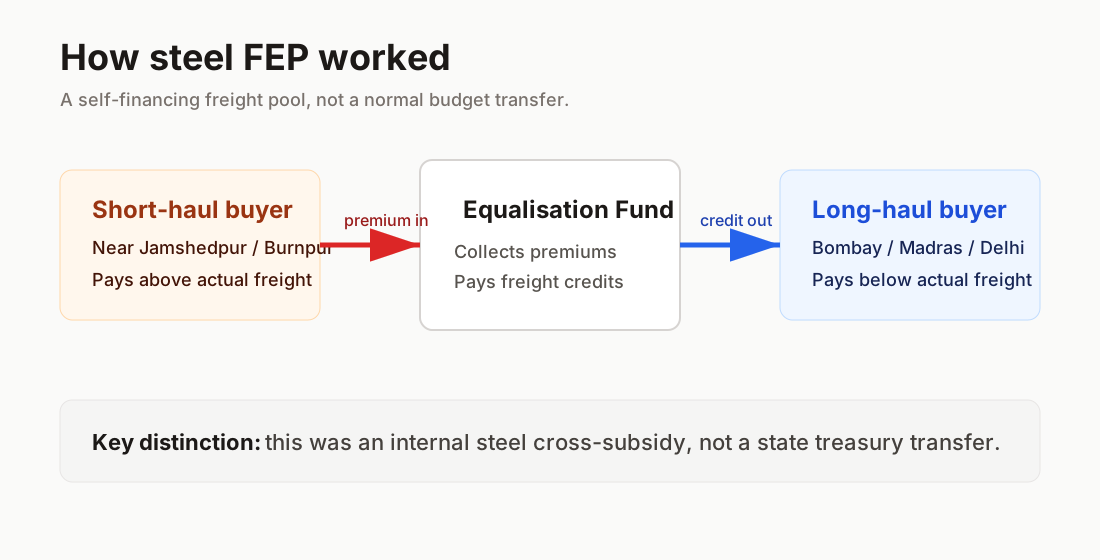
The standard narrative dates FEP from 1952. The 1952 date refers to early administered pricing of coal, but FEP-as-a-distinct-subsidy-policy for iron and steel began with the Second Five Year Plan in 1956. The Mahalanobis Plan was explicit: “Only by securing a balanced and co-ordinated development of the industrial and the agricultural economy in each region can the entire country attain higher standards of living.” The mechanism for steel was that the government, through the Tariff Commission and later (from 1964) the Joint Plant Committee, set a uniform “retention price” at the factory gate for products of integrated steel plants (ISPs), and a self-financing Equalisation Fund collected the difference between this price and actual short-haul freight costs, paying out the corresponding credits for long-haul shipments.
So the structure was: a mill in Jamshedpur sells steel at a regulated retention price. A buyer in Bhopal pays the same delivered price as a buyer in Mumbai, even though the actual rail freight to Mumbai is much higher. The Equalisation Fund balances the books. No money flows from any state’s treasury. No central budget allocation is required.
The fund was administered initially by the Tariff Commission, and from April 1971 (formalised by Notification S.O. 1567/ECS.COMM/IRON & STEEL of 7 April 1971) by the Joint Plant Committee under the Ministry of Steel. It was repealed on 16 January 1992 (Notification SC/1/6/91/D.III), with a residual “freight ceiling” regime continuing until 2001. The ceiling — 1125 km for pig iron, 1375 km for flats, 1400 km for bars, 1500 km for semis — was set so high that for most domestic users it didn’t bind.
II.2 Coal was not under FEP
This is the single most consequential correction your understanding needs. Most Indian commentary — including, embarrassingly, the Wikipedia article and several otherwise serious Substacks — claims coal was subject to FEP. It was not.
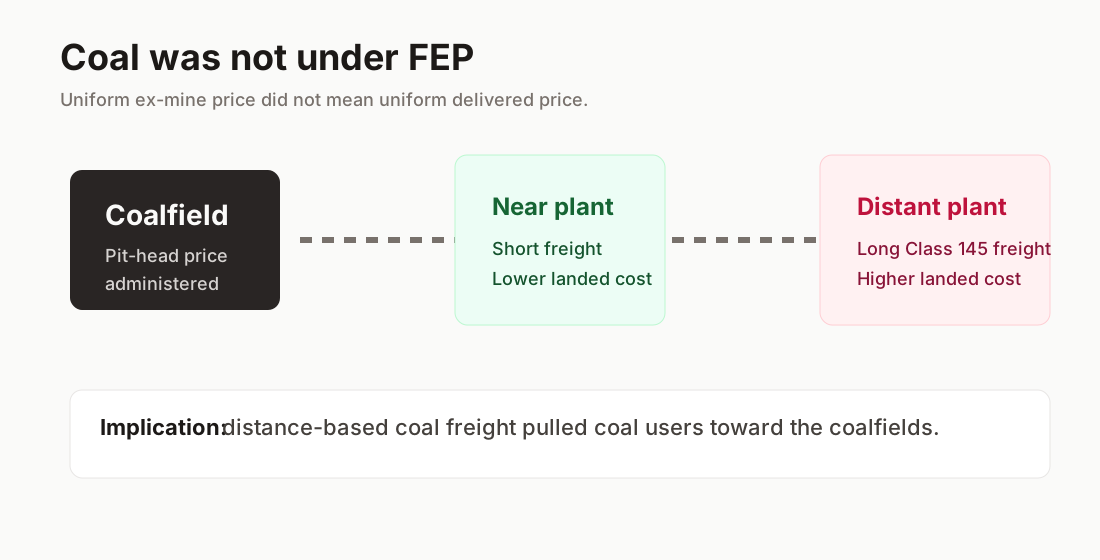
Coal had a separate pricing regime. Under Section 4 of the Colliery Control Order, 1945 (re-enforced by the Essential Commodities Act, 1955), the central government fixed the pit-head price of coal grade-wise and colliery-wise. This meant a buyer paid the same ex-mine price for grade-X coal regardless of which mine in the country produced it. But the transport of coal — the actual rail freight from Dhanbad to Madras or from Korba to Mumbai — was, and has always been, priced by distance.
In Indian Railways’ classification, coal sat (and still sits) in Class 145: charged at 1.45 times the basis rate per tonne-kilometre. This is the opposite of a subsidy: coal traffic paid above cost, generating revenue that was used to subsidise passenger fares. The 1.45x rating is well-documented in the Brookings Institution’s 2018 Indian Railways and Coal study and in Indian Railway Conference Association tariff tables. It was Indian Railways’ standard “freight overpays, passenger underpays” model.
So when you read commentary asserting that “FEP subsidised the transport of coal from eastern coalfields,” this is not correct. Coal transport was always paid for by the buyer, at a rate that exceeded its cost. What was uniform was coal’s ex-pit price, and that uniformity didn’t subsidise anyone — it just prevented producers in coalfields from charging differential prices to differential markets. The buyer in Madras paid more delivered cost for Bihar coal than the buyer in Patna did, because the freight was longer.
I belabour this because it matters for the rupee accounting. If you believe coal freight was equalised, you’d estimate the FEP subsidy at a much larger number — coal was always the largest commodity moved by Indian Railways (about 40% of tonne-kilometres and 45% of freight revenue). Strip coal out, and the subsidy applied only to iron, steel, cement, and fertilisers, of which steel was the only quantitatively significant one. Cement and fertilisers were spread across more dispersed production locations, so equalising their freight had less geographic impact. Iron and steel was the substantive policy.
The error matters in another way too. Many Indian commentators, when pointing to “FEP’s effect on coal-based industries,” are unwittingly attributing to FEP an effect that was actually structural: thermal power plants and steel plants located in eastern coalfields not because of any policy, but because moving coal long distances was always expensive. The fact that some coal-using industries did not relocate eastward is sometimes the very evidence offered for FEP’s malign effect — when in fact coal transport’s distance-based pricing was itself a force pulling such industries toward the coalfields.
II.3 The mechanism was a cross-subsidy, not a transfer
This is the part the standard story most badly garbles. The FEP subsidy was not a budget line item. It was not paid out of the central exchequer. There was no “FEP allocation” in the Union budget. The subsidy was an internal cross-subsidy with two components.
For steel, the cross-subsidy was contained inside the Equalisation Fund — short-haul shippers paid premium freight into the fund (their delivered price was higher than the actual cost-plus would have warranted), and the fund paid out credits to long-haul shippers (whose delivered price was lower than the actual cost-plus would have warranted). At any point in time the fund roughly balanced. It was self-financing. The government’s role was setting the retention price and administering the fund — not funding it.
For cement and fertiliser, similar dispersed equalisation funds operated, with the same structure.
For coal (which, again, was not formally under FEP), Indian Railways operated its own cross-subsidy: high freight rates on coal and other “Class 145+” commodities subsidised passenger fares and certain other commodity classes. This was, and is, the architecture of Indian Railways’ books — passenger losses are funded by freight surpluses. Coal users were net payers in this system, not beneficiaries.
So the question “which states paid for FEP” has, strictly speaking, no answer in cash terms. There is no inter-state fiscal flow to point to. The closest you can come is to identify who paid implicitly into the various cross-subsidies:
- Short-haul steel buyers (predominantly in eastern states, near the ISPs) paid above-cost freight, subsidising long-haul steel buyers (in western and southern states).
- Coal buyers everywhere paid above-cost freight, subsidising passenger services everywhere.
- The opportunity-cost loser was “what eastern industrial development would have happened in the counterfactual world without FEP” — which is a real cost, but it is not a cash transfer and cannot be billed to any state.
When eastern-state politicians demand “compensation” for FEP, what they are really demanding compensation for is the foregone industrial growth — a real economic loss but one that is impossible to quantify in cash without picking a particular counterfactual.
II.4 The coal subsidy that did exist — and which way it flowed
Section II.2 dispenses with the “coal was under FEP” claim. But there is a residual question worth confronting head-on, because critics of the contrarian view will raise it: wasn’t there some kind of coal subsidy, even if not a freight equalisation? The answer is yes — and once you trace where it flowed, it makes the contrarian thesis stronger, not weaker.
Coal India Limited (CIL), formed in stages between 1971 and 1975 from the nationalised coking and non-coking mines, operated under administered pit-head pricing. For much of the 1970s and 1980s, the administered price was held below the full economic cost of mining for several lower grades of coal. CIL ran losses; the central exchequer recapitalised it periodically; the cycle repeated. This was a real fiscal subsidy, paid out of central tax revenues collected from all states.
How big was it? CIL’s annual operating losses through the late-1970s and 1980s ran in the range of a few hundred to ~₹1,500 crore in nominal rupees, with peaks during oil shocks and wage settlements. Conservatively, average central support to the coal sector across 1973–1992 (the post-nationalisation FEP era) was on the order of ₹500 crore per year nominal, equivalent to roughly ₹10,000–15,000 crore per year at peak in 2024 rupees. Cumulative central fiscal subsidy to the coal sector across those nineteen years: of the order of ₹2–3 lakh crore in 2024 rupees — more than twice the entire FEP cross-subsidy.
Now follow the incidence. Cheap pit-head coal had two effects on industrial geography. First, it kept costs low for all coal users wherever they were located. Second, because the freight was distance-based and significant, the cost-saving was largest in absolute rupee terms for users near the coalfields. A power plant in Singrauli or a cement kiln in Jharkhand received cheap coal and paid trivial freight; a similar plant in Tamil Nadu received the same cheap pit-head price but had to pay 1500+ kilometres of Class-145 freight on top.
The result is that the coal subsidy did exactly what the freight regime did: it pulled coal-using industries toward the eastern coalfields. The Damodar Valley Corporation’s pithead generation model, NTPC’s heavy concentration of capacity in the eastern coal-belt (Singrauli, Korba, Talcher), the captive coal blocks of TISCO and SAIL, the colocation of sponge iron with coal in the Raipur-Bilaspur corridor — all of these were enabled, indeed economically necessitated, by the combination of low administered pit-head prices and distance-based freight. Strip away the coal subsidy, and many of these eastern industrial clusters would not have made economic sense in the locations they actually chose.
So the cross-state fiscal arithmetic of coal looks like this: central tax revenues — disproportionately collected from Maharashtra, Gujarat, Tamil Nadu, Karnataka and the high-GDP states — were used to subsidise coal pit-head prices, with the largest absolute benefit going to coal-using industries clustered in the eastern coal-belt. The transfer ran south-and-west to east, not east to south-and-west. It is the mirror image of the FEP grievance.
This doesn’t make the eastern states “wrong” to have built industry around their coal advantage — it was rational, indeed it was the explicit intent of the planners. But it does mean that any honest fiscal accounting of the FEP era must net out this flow. The east lost some steel-related freight advantage to FEP (call it ₹50,000–₹1,00,000 crore in 2024 rupees over thirty-five years) and gained a substantially larger coal-related fiscal advantage over the same period (of the order of ₹2–3 lakh crore in 2024 rupees over nineteen years). The arithmetic, properly tabulated, looks more like a net positive transfer to the east than a net subsidy from the east — even before we get to the post-1990 tax-devolution explosion that is the subject of Section IV.
II.5 The four-commodity framework: iron, steel, coal, cement
People who want FEP to be the cause of eastern decline will keep moving the goalposts between commodities. Pinned down on coal, they switch to iron ore. Pinned down on iron ore, they switch to bauxite. Pinned down on cement freight, they argue about pit-head pricing. The conversation never lands because the underlying mechanisms get conflated.
Here is the proper four-by-four matrix. Every claim about FEP-era pricing falls into one of these cells, and each cell has a different incidence story. Read across:
| Iron ore | Steel (ISP output) | Coal | Cement | |
|---|---|---|---|---|
| Was it under FEP / FES? | No — moved as raw input to ISPs at distance-based rates | Yes — equalised by Joint Plant Committee from 1956–1992 | No — Wikipedia and popular accounts get this wrong | Yes — separate fund, smaller scale |
| Ex-source price control? | Royalty paid to states; mostly captive | ”Retention price” set by JPC, uniform | Pit-head price set under Colliery Control Order 1945 | Notified ex-factory price |
| Freight regime | Distance-based, IR Class 160-170 (high) | Equalised by Equalisation Fund | Distance-based, IR Class 145 (45% above basis) | Equalised within scheme |
| Effective delivered price across India | Varies sharply by distance | Uniform | Varies sharply by distance | Uniform |
| Geographic incidence on the east | Captive flow to ISPs; minor effect | Eastern advantage neutralised — this is the real grievance | Eastern advantage preserved (cheap pit-head + low freight) | Equalised, but cement was less concentrated to start with |
| Direction of net subsidy flow | Within-state royalty issue, mostly | East → West/South via Equalisation Fund | West/South → East via central tax → CIL fiscal subsidy | Modest, similar to steel |
| Cumulative scale, 2024 ₹ | Not applicable (no equalisation) | ₹50,000 cr to ₹1.5 lakh cr | CIL fiscal subsidy ~₹2-3 lakh cr (opposite direction) | <₹50,000 cr (smaller fund) |
The single most important row is the direction of net subsidy flow. Steel ran east-to-west/south. Coal ran west/south-to-east. Cement was much smaller in scale and ran east-to-west/south. Iron ore wasn’t really part of the cross-subsidy at all — it moved captively from mines to ISPs at full distance rates, with the resulting steel then being equalised.
If you net these properly across the FEP era, the eastern states received a larger fiscal transfer through the coal regime than they paid through the steel regime. The popular framing — “the central government took our minerals and gave them to the south at our expense” — runs the wrong way for three of the four commodities.
II.6 The energy-adjusted coal argument
A separate-but-related argument occasionally surfaces: that Indian thermal coal, on a calorific-value-adjusted basis, was expensive compared to seaborne imported coal, and therefore southern India was paying an “efficiency tax” by being forced to use domestic coal. This argument is half-right and half-wrong, and it is worth disposing of carefully.
What’s right: Indian thermal coal genuinely is high-ash and low-CV (~3,800 kcal/kg versus ~6,000 kcal/kg for the Australian Newcastle benchmark). When you adjust ₹/tonne to ₹/mkcal, the cost gap changes materially. The “ash haulage tax” — paying freight on rocks that become fly ash — is real. Power plants designed for low-CV high-ash coal are larger, more expensive, and carry higher O&M costs.
What’s wrong with the conclusion that this was a regional South-paid-East subsidy:
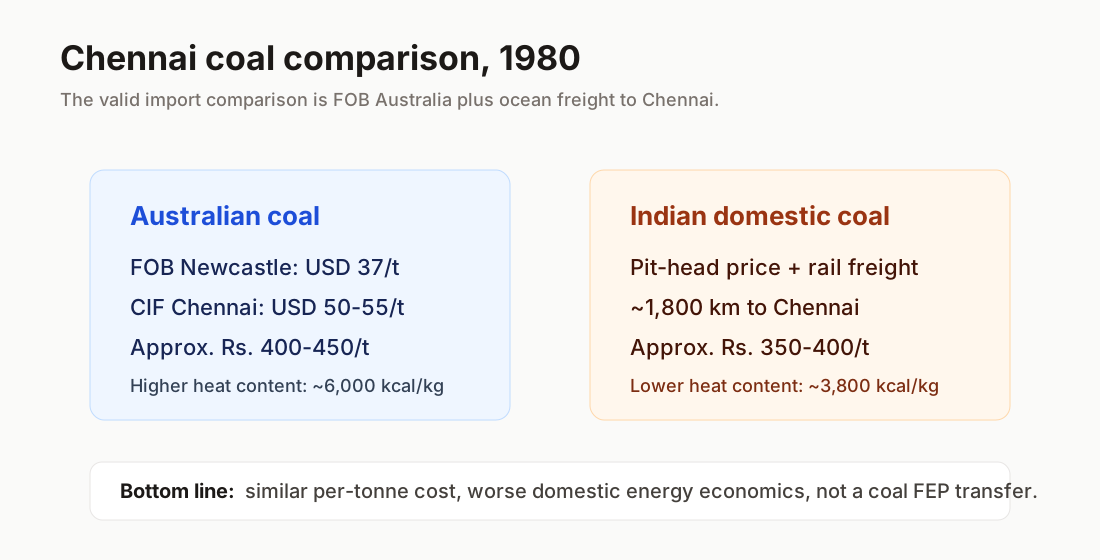
First, the clean comparison is Australia FOB/CIF Chennai, not a vague “cheap Asian coal” counterfactual. The Australian Newcastle benchmark FOB price in 1980 was around USD 37/tonne. CIF Chennai for Australian coal in 1980 would have been in the USD 50-55/tonne range, equivalent to roughly ₹400-450/tonne at the prevailing exchange rate of $1≈₹7.86. Compared to a delivered Indian coal price at Chennai of around ₹350-400/tonne (pit-head + ~1800 km of telescopic freight), the per-tonne cost gap in 1980 was small to non-existent.
Second, the energy-adjusted comparison is where imported coal looks better. Australian coal at ~6,000 kcal/kg versus Indian thermal coal at ~3,800 kcal/kg means an Indian buyer needs roughly 1.6 tonnes of domestic coal to obtain the same heat content. On a useful-energy basis, the domestic-coal regime imposed a real efficiency cost, especially on distant users who paid rail freight on ash.
Third, even where Indian coal was inefficient on a global energy-adjusted basis, the inefficiency tax was paid by every Indian coal user, everywhere in the country, not just by southern users. A power plant in Maharashtra paid it. A plant in Punjab paid it. So did plants in eastern states using local coal — they got the same low-CV, high-ash product, just with shorter freight. The premium was a national-level inefficiency tax stemming from forex controls and protectionist energy policy, not a regional cross-subsidy from south to east.
Fourth, the regional incidence within India runs in the opposite direction from the “South paid for the East” story. Eastern coal users got cheap, low-CV coal with low freight. Southern coal users got the same cheap, low-CV coal with high freight. In delivered ₹/mkcal terms, the South paid more than the East. But this was a freight differential arising from geography and IR’s distance-based rates — not a subsidy from the South to the East. The South wasn’t paying the East’s coal bill; the South was paying its own much-larger freight bill on top of the same low-quality coal. The proper complaint is about freight cost on bad coal, and it’s a freight-regime complaint, not an “I subsidised your industry” complaint.
The honest version of this argument is: India’s domestic coal regime imposed a real efficiency cost on the entire economy, paid by all Indian coal users in the form of higher delivered cost per unit of useful energy than a freer import-and-forex regime might have offered. This is a fair critique of the 1956-91 industrial policy regime. But it is a national-level critique with national-level incidence, not a regional cross-subsidy story. The compression “the South paid for the East’s mines” misrepresents both the direction of the actual transfer and the nature of the cost.
III. The arithmetic of the subsidy
III.1 What the 1977 IMG Report concluded
In 1977, the Government of India Planning Commission constituted an Inter-Ministerial Group (IMG) to evaluate the freight equalisation regime. Its report — Report of Inter-Ministerial Group on Freight Equalisation of Commodities, 1977 (catalogued in the Niti Aayog library, biblionumber 41958) — concluded that the size of the subsidies was small relative to firms’ final output prices, and could not, by themselves, account for the geography of production.
This conclusion has been used by both sides of the debate. Pro-FEP defenders cite it as proof FEP was harmless. Anti-FEP critics cite it as proof the government was in denial. Both are wrong. The IMG was correctly observing the immediate magnitude of the subsidy. What it failed to anticipate was the cumulative effect over decades, which Firth and Liu (2018) later quantified.
III.2 What I can estimate, with caveats
Cleanly aggregated rupee figures for the total FEP subsidy do not exist. The subsidy was an internal cross-subsidy, not a budget item, and the JPC’s archives are not publicly digitised for the full period. What I can do is build an order-of-magnitude estimate from secondary indicators.
The relevant magnitudes for the FEP-peak year (let’s take 1985–86):
- Iron and steel tonnage moved by Indian Railways: roughly 25–30 million tonnes annually.
- Average lead distance for iron and steel under FEP: roughly 1000 km (national average; eastern-origin shipments to western/southern destinations were 1500–2000 km).
- Per tonne-km freight rate for iron and steel in 1985: roughly ₹0.10–0.15 in nominal rupees of the time.
- The “subsidy” is the difference between what a long-haul shipment paid (the equalised price) and what it would have paid at distance-based rates. For a 2000-km shipment versus a 700-km national average, that’s roughly 1300 km × ₹0.12 = ~₹160 per tonne. Applied to perhaps half the iron-and-steel tonnage (the half that was “long-haul” in the relevant sense): ~12 million tonnes × ₹160 = ₹192 crore in 1985 nominal rupees.
Adjusting for inflation between 1985 and 2024 using the CPI (a factor of roughly 18–20), this becomes ~₹3,500–4,000 crore in 2024 rupees per year at peak.
Multiplying across the 35 years of FEP, with the subsidy starting small (1956) and growing as iron/steel tonnage grew, a back-of-the-envelope cumulative estimate is on the order of ₹50,000–1,50,000 crore in 2024 rupees. Call it ₹1 lakh crore as a round number.
This is not a small sum. But it is also not the order of magnitude that popular discourse implies — which often suggests that hundreds of thousands of crores per year were being implicitly taken from the east. The cumulative subsidy over 35 years is roughly equivalent to two years of present-day MGNREGA spending, or about 0.4% of one year of India’s current GDP.
III.3 As a percentage of national GDP
In 1985–86 nominal terms, India’s GDP was approximately ₹2.6 lakh crore. A FEP subsidy of ₹150–250 crore represents 0.06–0.10% of GDP. This is consistent with the IMG’s “small fraction” conclusion.
For comparison:
- India’s fertiliser subsidy in the same year was approximately ₹1,800 crore — about 10x the size of the FEP cross-subsidy.
- India’s food subsidy was approximately ₹1,650 crore.
- The “implicit petroleum subsidy” via administered pricing was several thousand crore.
By every comparable measure, FEP was a small subsidy in cash terms. The standard story’s implication that FEP was a major fiscal phenomenon is simply wrong.
III.4 As a percentage of commodity prices
For steel: the average FEP subsidy per tonne, applied to long-haul shipments, was perhaps 10–15% of the delivered price (not the ex-factory price). For the longest hauls — Jamshedpur or Bokaro to Trivandrum or Coimbatore — the subsidy could approach 25–30% of delivered price. For short hauls, the “subsidy” was actually negative: the buyer was paying above cost.
For iron ore: not directly subsidised under FEP, but shipped to ISPs which set retention prices. The geography is opposite: iron ore went to the ISPs (mostly in the east), so eastern ore-haulage was relatively short, and the equalisation question barely arose.
For cement and fertiliser: similar 10–15% range for long hauls, less for short hauls.
In other words, the FEP subsidy was a meaningful but not enormous wedge in delivered prices — large enough to nudge marginal location decisions, not large enough to be the determinative factor for major plant locations. This is precisely what Firth and Liu’s empirical results show.
IV. What the data actually says
IV.1 The state GDP trajectory
Here is the most authoritative data we have on state economic shares — from the September 2024 PM-EAC working paper by Sanjeev Sanyal and Aakanksha Arora, drawing on MoSPI data, in current prices, with adjustments for state bifurcations.
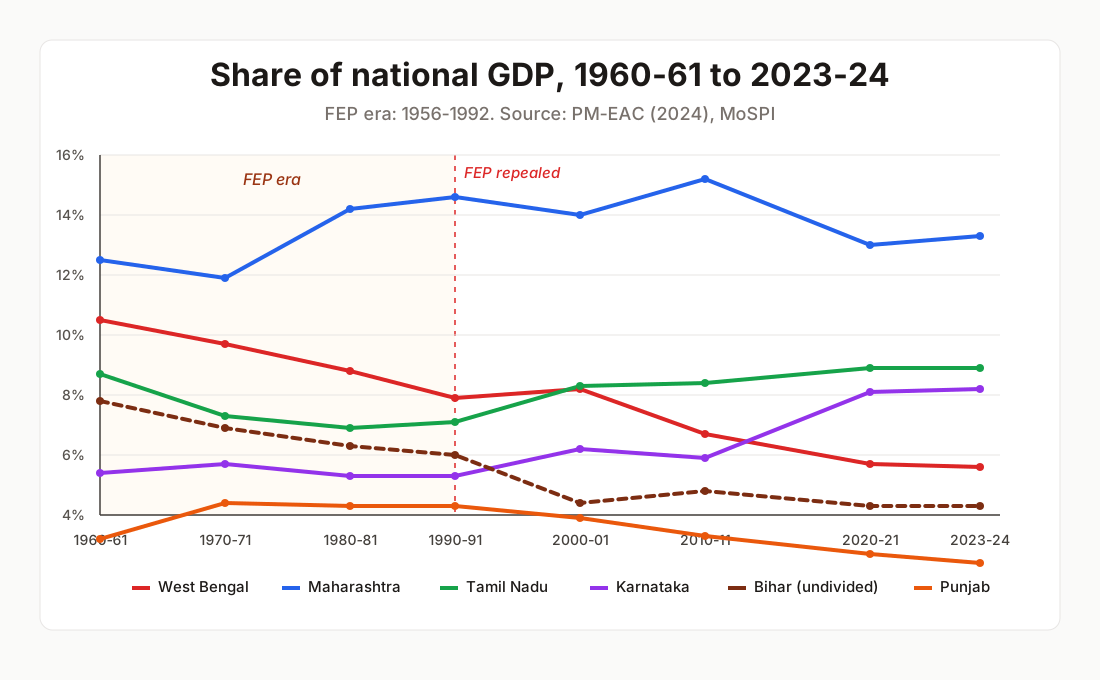
A few things jump out from this chart that are very hard to reconcile with the strong-FEP narrative:
-
West Bengal’s decline is monotonic across the entire period — including before FEP could plausibly have had time to bite. From 1960-61 (10.5%) to 1970-71 (9.7%) — the first decade of FEP — WB lost roughly 0.8 percentage points of share. From 1990-91 (7.9%) to 2023-24 (5.6%) — the entire post-FEP era — WB lost 2.3 points. So the post-FEP decline was worse than the FEP-era decline. If FEP were the dominant cause, you’d expect the rate of decline to flatten or reverse after 1992, not accelerate.
-
Maharashtra was already #2 in 1960-61 with 12.5% share — a number it had attained pre-FEP via Bombay’s pre-existing industrial cluster. Maharashtra’s gain from 1960 to 1990 is about 2 percentage points. If FEP “transferred industry to Maharashtra,” that 2-point gain is the maximum size of the transfer — but it could equally be explained by post-1947 agglomeration logic that had nothing to do with steel freight.
-
Punjab’s industrial share plateaued through the FEP era and has fallen sharply since. This is the opposite of what you’d expect if FEP were boosting Punjab’s industry. Punjab’s apparent rise from 3.2% (1960) to 4.4% (1970) is the Green Revolution in agriculture, not FEP-induced manufacturing.
-
Tamil Nadu and Karnataka’s gains are entirely a post-1991 phenomenon. Their FEP-era trajectories were flat to declining. Tamil Nadu fell from 8.7% in 1960 to 7.1% in 1990; Karnataka was 5.4% in 1960 and 5.3% in 1990. They started rising only after liberalisation, IT services, and education-driven specialisation took hold. None of this is FEP.
-
Undivided Bihar’s decline is gentle through the FEP era (7.8% → 6.0% over 30 years; about 0.6% per decade) and accelerates into the 2000-01 jump-down due to bifurcation with Jharkhand. Bihar’s worst per-capita-relative decline came after FEP repeal.
You can fit the FEP-as-villain story to this data only if you believe (a) effects took 30+ years to fully materialise, and (b) the post-1992 effects are largely bygone-momentum rather than ongoing harm. That is essentially the Firth-Liu position — and even they find that the magnitudes are modest (0.5 percentage points of annual growth differential), not catastrophic.
IV.2 What Firth and Liu (2018) actually found
The most rigorous econometric study of FEP available is John Firth and Ernest Liu’s Manufacturing Underdevelopment: India’s Freight Equalization Scheme, and the Long-run Effects of Distortions on the Geography of Production (NEUDC 2018, Cornell University). It uses a triple-difference design exploiting state-by-industry variation: states differ in distance from the original Integrated Steel Plants, industries differ in iron-and-steel intensity, and FEP’s intensity varies over time.
Their main findings:
- FES (their term) gave iron-and-steel-using industries in distant states a roughly 0.5 percentage point annual growth advantage over comparable industries in proximate states. Downstream industries got a slightly larger 0.6 percentage point boost.
- This effect was gradual: barely visible in the 1956–1970 window, accumulating through the 1970s and 1980s, reaching its full magnitude only by 1990.
- Effects were symmetric on repeal: when FEP was lifted in 1992, iron-and-steel-using industries moved back toward the steel sources at exactly the same pace.
- Stickiness from agglomeration was minimal — the lifting of FEP undid most of the locational distortion within about a decade.
- BUT: West Bengal and Bihar didn’t fully recover, because new ISPs had been built during the FEP era (Bhilai, Rourkela, Bokaro, Durgapur, Vizag), so the gains from repeal got dispersed across these new locations rather than concentrating back in WB and Bihar.
This is a much more nuanced picture than the popular narrative. FEP was real, it had measurable effects, but the effects were modest in any single year, took decades to compound, and largely reversed after repeal. The persistent gap between east and west has other origins.
The critical sentence from Firth and Liu’s conclusion is worth quoting in their own words: the distortions related to FES cause industries to move across space, but stickiness due to agglomeration and entrenched advantage was not the mechanism for the persistent east-west gap. In other words, FEP is not why Bengal didn’t recover.
V. The Punjab paradox
Now consider Punjab — the state most often cited as a “FEP beneficiary” in the standard narrative. Punjab supposedly benefited because, distant from the eastern coalfields and steel belt, it could now access subsidised freight for its industrial development.
Look at the data:
- 1960-61: Punjab’s GDP share was 3.2%; its per-capita income was 119.6% of the national average.
- 1970-71: GDP share rose to 4.4%; per-capita income spiked to 169% (reflecting the Green Revolution).
- 1980-81: GDP share fell back slightly to 4.3%; per-capita income to 146%.
- 1990-91: GDP share still 4.3%; per-capita income 146.7%.
- Post-FEP (2023-24): GDP share has fallen to 2.4%; per-capita income to 106.7% — lower than 1960-61.
Three things are striking. First, Punjab’s GDP share plateaued through the entire FEP era from 1970 to 1990. This is the opposite of what FEP-as-Punjab-boon would predict. Second, Punjab’s per-capita income peak in 1970-71 was caused by the Green Revolution in agriculture, not by industrial in-migration. Third, Punjab’s post-FEP trajectory has been one of relative decline — which would be inexplicable if FEP had been the source of its prosperity.
What actually happened in Punjab? The Green Revolution made agriculture extraordinarily profitable, capital-intensive, and productive. State policy (procurement, MSP, subsidised power, fertiliser subsidies) reinforced agricultural specialisation. The state never industrialised significantly: Sanyal and Arora suggest this is a textbook case of agricultural Dutch disease — a sector grew so profitable that it crowded out diversification into manufacturing. When the Green Revolution’s relative advantage faded post-1990, Punjab had no industrial base to fall back on.
The neighbouring state Haryana — separated from Punjab in 1966, with similar agricultural endowments — did industrialise. By 2023-24, Haryana’s per-capita income was 176.8% of the national average; Punjab’s was 106.7%. The difference is policy: Haryana courted manufacturing aggressively, Punjab didn’t. Neither difference has anything to do with FEP.
The “Punjab benefited from FEP” claim is, on inspection, almost entirely empty. Punjab benefited from the Green Revolution, then squandered the dividend by failing to industrialise. FEP was not the cause of either outcome.
VI. The Maharashtra agglomeration head-start
Maharashtra — and especially Bombay — is the other state most often cited as a FEP beneficiary. Here too the data tells a more boring story.
Bombay was already India’s premier industrial city in 1947. It had been the industrial centre of the Bombay Presidency under British rule, with a major textile industry, an established commercial class, the country’s first stock exchange, and a deep maritime trade network. By 1960-61, Maharashtra (which had only just been carved out of the Bombay state) had the second-highest share of national GDP at 12.5%, second only to undivided Uttar Pradesh.
If you carefully date Maharashtra’s relative gains, the picture is:
- 1960-61: 12.5%
- 1970-71: 11.9% (a slight decline)
- 1980-81: 14.2%
- 1990-91: 14.6%
- 2023-24: 13.3%
Maharashtra gained roughly 2 percentage points across the entire FEP era — modest. Notice also that almost half of this gain came before 1980 (6.6% to 14.2%), at a time when (per Firth and Liu) FEP’s effects on industrial location were minimal. Maharashtra’s 1970–1980 gain coincides with the post-Bombay-Plan industrial momentum, the construction of the Bombay-Pune industrial corridor, and the establishment of Tata Motors, Mahindra, and others — most of which were responding to agglomeration economics in Bombay, not to subsidised steel freight from Jamshedpur.
The agglomeration logic is brutal and largely policy-independent. Once a city has a deep labour market, capital market, supplier network, and customer base for industrial goods, marginal new investment goes there. The marginal cost of locating in Bombay drops below the marginal cost of locating elsewhere, even with no freight subsidies. This was true of Bombay in 1947, was reinforced by every decade of subsequent industrialisation, and would have been true with or without FEP.
To the extent FEP added a small additional pull toward Bombay (via cheaper steel for non-coastal users), it was reinforcing a tide that was already flowing. Take FEP away in some counterfactual, and Maharashtra would still have been the dominant industrial state — perhaps 11–12% share in 1990 instead of 14.6%, but still #1.
VII. Why the southern states’ rise has nothing to do with FEP
Tamil Nadu and Karnataka’s economic ascent is a feature of the post-FEP era. Look at the share data:
- Tamil Nadu: 8.7% (1960) → 7.1% (1990) → 8.9% (2024). The state lost share through the entire FEP era and gained it back only post-liberalisation.
- Karnataka: 5.4% (1960) → 5.3% (1990) → 8.2% (2024). Roughly flat through FEP, gained heavily after.
- Andhra Pradesh + Telangana: 7.7% (1960) → 7.6% (1990) → 9.7% (2024). Same pattern.
If FEP had been a major boon to southern states, you’d expect their share to rise during the FEP era. It didn’t. The southern rise is post-1991, driven by:
- IT services and software exports (Bangalore, Hyderabad, Chennai)
- Auto and component manufacturing clusters (Chennai)
- A more disciplined fiscal and regulatory environment
- High investment in higher education going back to the 1960s, paying off when the global services economy emerged
- A diaspora that funnelled capital and connections back home
None of this is FEP. The southern states’ policy-quality and human-capital investments have done the work; FEP simply did not move the needle on their relative position during the era it was in force.
VIII. The mineral-belt states that did okay
Your earlier question was sharp: are there mineral-belt states that did better? Yes, and the comparison is instructive.
Odisha: persistently a laggard from 1960 to 1990 (relative per-capita income falling from 70.9% to 54.3% of national average), but has executed a notable turnaround since 2000. Its relative per-capita income is now 88.5% — higher than West Bengal’s. Odisha’s recovery is built on aluminium and steel investments (Vedanta, JSW, Tata Steel Kalinganagar), better governance under Naveen Patnaik, and the careful exploitation of its iron ore and bauxite resources for domestic processing. Odisha shows what the eastern model could have looked like.
Madhya Pradesh and Chhattisgarh: MP turned around after 2010, with relative per-capita income rising from 60.1% to 77.4%. Chhattisgarh, separated from MP in 2000, has stabilised at 80% of national average and is the largest freight-loading railway zone in the country (South East Central Railway), driven by coal from the Korba and Mand-Raigarh fields.
Goa: A genuine outlier. Goa has both mineral wealth (iron ore exports were the dominant export until court-ordered mining halts) and tourism, and has the second-highest per-capita income in India after Sikkim — roughly 290% of the national average.
Andhra Pradesh / Telangana: Telangana, post-bifurcation, has a per-capita income at 193.6% of national average — among the highest in India. It has substantial mineral resources (coal in the Singareni belt) and has built modern services and manufacturing on top.
The pattern: mineral wealth is not destiny in either direction. States that combined resource extraction with downstream processing, decent governance, and a willingness to court manufacturing have done well. States that combined resource extraction with poor governance, political instability, and labour-relations problems have done poorly. The FEP variable is not what differentiates these outcomes.
West Bengal’s specific failure — having both minerals (admittedly less than Bihar/Jharkhand/Odisha) and industry and an educated workforce, and still declining — is not explained by FEP. It is explained by the choices the state and its political leadership made, the violence its labour relations descended into, and the asymmetric central treatment it received.
IX. Who actually paid: cross-subsidy mechanics
Strictly: nobody, in cash terms. FEP was an internal cross-subsidy. There were no inter-state fiscal transfers, no central budget allocations, no tax revenues drawn from State A to subsidise factories in State B.
What there was, more loosely:
For steel: the Equalisation Fund, administered by JPC, was self-financing. Short-haul shippers paid more than cost-of-freight-plus into the fund. Long-haul shippers drew the difference. Over any period, the fund balanced. The implicit cost-bearers were therefore (a) short-haul steel buyers, mostly located in eastern industrial centres, and (b) the long-distance ones, mostly located in western and southern centres, were the implicit beneficiaries. But there was no taxpayer-funded transfer.
For coal (not under FEP, despite popular claims): coal was nationalised in two stages (coking 1971-72, non-coking 1973), and pit-head pricing was administered via the Colliery Control Order. There was no cross-state freight subsidy for coal. Indian Railways’ freight rate on coal was, and is, Class 145 — paying 1.45x basis. This is actually a negative subsidy to coal users — they paid above-cost freight, and the surplus was used by Indian Railways to subsidise passenger fares everywhere.
For Indian Railways more generally: the “freight overpays, passenger underpays” model meant that all bulk-commodity freight users were implicitly subsidising passenger services. Coal alone has historically been about 40% of Indian Railways’ tonne-kilometres and 45% of freight revenue. To the extent there is a cross-subsidy story, it is between freight users (who paid above-cost) and passenger users (who paid below-cost) — and that story has very little to do with state-level redistribution.
For central tax devolution generally: this is a separate question. The central government’s revenues during the FEP era came from corporation tax, income tax (a small base), customs and excise (the biggest source, about 60% of central revenues at the time), and various non-tax sources. The state-wise origin of central tax revenue is genuinely hard to compute and is not the same question as “who paid for FEP.” Maharashtra’s high contribution to central revenues reflects Bombay’s commercial dominance, and that revenue funds all central activities — defence, central public sector enterprises, food subsidies, fertiliser subsidies — of which FEP’s cross-subsidy was, as we’ve seen, 0.05–0.10% of GDP, well below noise level for fiscal accounting.
Eastern-state politicians who frame “Maharashtra extracted from Bihar via FEP” are doing political rhetoric, not economic accounting. The actual fiscal flow is the reverse: Bihar today is a major net recipient of Finance Commission devolution; Maharashtra is a major net contributor.
The honest framing of the “compensation” question — which I think does have moral weight — is: the eastern states bore the opportunity cost of foregone industrial development, which was a real economic loss with no market price. Quantifying that loss requires a counterfactual, which can be constructed only with assumptions. Firth and Liu’s empirics suggest the magnitude is modest at the margin, large in cumulative effect, and partially reversed by FEP repeal — but never fully reversed because of the new ISP locations.
X. The repeal and the residual stickiness
The National Development Council met in December 1991 and announced the repeal of FEP for iron and steel with effect from 16 January 1992. A residual “freight ceiling” regime continued until full repeal in 2001, but the ceilings were so high (1125–1500 km depending on product) that they didn’t bind for most users.
The empirical effect of repeal, per Firth and Liu, was almost exactly symmetric with the implementation effect. Iron-and-steel-using industries moved back toward the steel sources at the same magnitude they had moved away. The new equilibrium, by about 2002, had iron-and-steel-using industry distributed roughly as it would have been in a non-FEP world — except for one important asymmetry.
Between 1956 and 1992, the central government had built five new ISPs: Bhilai (Madhya Pradesh, now Chhattisgarh), Rourkela (Odisha), Bokaro (Bihar, now Jharkhand), Durgapur (West Bengal), and Vizag (Andhra Pradesh). These plants were built partly to reduce average shipping distances under FEP. After FEP was repealed, iron-and-steel users moving “back toward” steel sources distributed themselves across all seven ISP locations, not just the original two (Tata Jamshedpur and IISCO Burnpur).
So the partial recovery for West Bengal and Bihar after 1992 was real, but smaller than a full reversal would have been. WB and Bihar got some of the gains from repeal; Madhya Pradesh, Odisha, and Andhra Pradesh got the rest. This is the part of the FEP narrative that is genuinely correct: WB and Bihar didn’t fully recover, and the reason has to do with the new ISP geography, not with permanent agglomeration lock-in.
The political-economy reading of this is: the central government’s plant location decisions during the FEP era did more to permanently shape Indian industrial geography than the freight subsidy itself ever did. If you want to assign blame for “Bengal’s loss,” start with the decision to build Bhilai in MP and Vizag in AP rather than expanding Burnpur and Durgapur — those were political decisions about geographic balance, made consciously, and they had structural effects.
XI. Coda: what this means for thinking about regional policy today
A few takeaways that generalise beyond the FEP question:
-
Causal attribution in regional economics is genuinely hard, and popular narratives tend to over-simplify in motivated ways. The PM-EAC’s 2024 paper on relative state performance is excellent precisely because it avoids causal claims and just shows the data. When commentators attach causes to that data, the causes tend to align with their priors.
-
The empirical effects of large industrial-policy interventions often take 20–30 years to fully appear. This is true of FEP. It is also true of liberalisation (the southern states’ rise didn’t peak until 15–20 years after 1991). It is true of the Green Revolution (Punjab’s per-capita peak was 1970-71, almost a decade after wheat-yield miracles began). Policy debates that argue effects ought to be visible within 2–3 years are using the wrong time horizon.
-
Cross-subsidies are politically opaque and often underrated as a policy tool. FEP cost the central exchequer no money in the conventional sense — it was self-financing. This is part of why it persisted: there was no annual budget line item to debate. Today’s equivalents — implicit cross-subsidies in electricity tariffs, in PDS pricing, in public-sector banks’ lending — operate the same way. They are large in cumulative effect but low in political visibility.
-
Institutions and human capital outweigh resource endowments at long horizons. Tamil Nadu’s success has nothing to do with minerals; Punjab’s stagnation has nothing to do with their absence. The state-level variable that most consistently predicts long-run economic performance is governance quality — fiscal discipline, regulatory predictability, education investment, infrastructure delivery. Mineral wealth is, in the limit, a red herring. The success of mineral-poor southern states and the failure of mineral-rich eastern ones is the data point that should sit at the centre of any mature analysis of Indian regional development.
-
For policy makers today: the FEP debate is largely settled and largely irrelevant to current policy decisions. The substantive questions for regional development are about urbanisation patterns, manufacturing zone strategies, education outcomes, electricity reliability, and labour-law reform. None of these are downstream of freight pricing. We should stop fighting the last war, the one we lost a generation ago, and focus on the policy fights that actually determine outcomes for the next generation.
Appendix A: The coal claim, verified with primary sources
This appendix exists because the contrarian thesis stands or falls on a single empirical claim — coal had uniform pit-head pricing but distance-based freight, and was not formally under FEP — and that claim is challenged repeatedly by readers who have encountered the opposite assertion in popular sources. The popular sources are wrong. Here is the documentation, organised by sub-claim, so that the next time someone says “but Wikipedia says coal was under FEP,” this appendix can be cited in reply.
Sub-claim A.1: Coal had uniform, government-administered pit-head pricing
This is not in dispute and is supported by both popular and scholarly sources. The legal mechanism was Section 4 of the Colliery Control Order, 1945, re-enforced by Section 16 of the Essential Commodities Act, 1955, which empowered the Central Government to fix grade-wise and colliery-wise prices of coal. This regime ran until 1.1.2000, when it was superseded by the Colliery Control Order, 2000.
Primary sources:
- Ministry of Coal, Government of India. “Pricing of Coal.” Available at coal.gov.in/sites/default/files/2019-11/pricing_0_0.pdf. The official government statement: “Prior to 1.1.2000 the Central Government was empowered under section 4 of the Colliery Control Order, 1945, as continued in force by the Essential Commodities Act, 1955, to fix the grade-wise and colliery-wise prices of coal.”
- Singareni Collieries Co., Ltd. v. Commissioner of Commercial Taxes, Hyderabad, All India Reporter (AIR) judgment — multiple Supreme Court cases reference the regulatory mechanism.
- Observer Research Foundation. “Coal Pricing in India: The High Cost of Low Prices.” 2018, summarising the price-fixing mechanism: “the GOI fixed grade-wise and colliery-wise price of coal under section 4 of the colliery control order 1945 which was re-enforced by the essential commodities act 1955.”
This sub-claim is uncontroversial. The same grade of coal had the same notified ex-mine price across India, throughout the FEP era and until 2000.
Sub-claim A.2: Coal freight was distance-based throughout, never freight-equalised
This is the sub-claim that conflicts with popular narrative. The evidence:
A.2.1 — The leading academic study explicitly states this and cites primary sources.
Firth and Liu (2018), the most rigorous econometric analysis of FEP available, addresses this question directly in footnote 2 of their working paper:
“Some sources have erroneously stated that coal was subject to FES (Chakravorty and Lall, 2007). This is not quite correct. Coal production is a state enterprise and has been subject to a series of controls ensuring uniform pricing across markets, however the transportation has essentially always been priced based on distance (Raza and Aggarwal, 1986; Indian Railway Conference Association, 2000).”
The two cited sources are Raza and Aggarwal’s Transport Geography of India (1986), an academic monograph, and the Indian Railway Conference Association’s tariff schedules (2000) — the official IR document that defines freight rates by class and distance.
A.2.2 — Indian Railways’ own tariff classification confirms distance-based pricing, with coal in Class 145.
The Brookings India / CSEP (2018) study Indian Railways and Coal: An Unsustainable Interdependence (Kamboj and Tongia) defines the relevant terminology in its glossary:
“Class: Categorisation of rate for freight by category compared to a class 100 being a basis. Class 145 for coal means being charged per tonne kilometre (TKm) 1.45 times that charged for a class 100 good.”
“Per tonne kilometre” is the operational definition of distance-based pricing. If freight were equalised, the rate would be a flat per-tonne charge regardless of distance, which it has never been for coal.
A.2.3 — The Government of India has confirmed this in Parliament as recently as 2018.
In Lok Sabha Unstarred Question No. 1264, the Ministry of Coal answered:
“…charged at Class 145A/145B and freight rate per tonne for this class for different distance slabs is enclosed as Annexure A. These rates have been notified w.e.f. 01.11.2018 and uniformly applicable for all customers.”
The same answer continues:
“Coal is supplied to power plants through various modes of transportation like Rail, Road, MGR, belt, ropeway, etc. The landed cost of coal at power plants includes cost of coal and transportation cost of coal and hence, for power plants located far off from the mine, the landed cost of coal increases. Thus, the transportation cost of coal directly affects landed [cost].”
The government, answering a formal parliamentary question, explicitly states that landed coal cost varies with distance. By definition, that is not equalisation.
A.2.4 — The Supreme Court of India categorised coal freight as “actuals” (i.e., distance-based) as early as 1953.
In a 1953 ruling on coal pricing under the Colliery Control Order (Supreme Court India case 978), the Court enumerated the legally permissible components of coal pricing:
“1. Ex-colliery Price — Actuals… 2. L.D.C.C. and Bihar Sales tax — Actuals… 3. Middleman’s commission — Actually paid… 4. Railway freight — Actuals… 5. Incidental and handling charges…”
The Court itself, three years before FEP for steel was introduced, treated railway freight as a separate “actuals” component — distinct from the administered ex-colliery price. This is contemporaneous primary legal evidence that distance-based coal freight was the operative regime at the very start of the FEP era. It remained the regime throughout.
A.2.5 — Empirical evidence: delivered coal prices vary by distance, today and historically.
The Economic Research Institute for ASEAN and East Asia (ERIA) in Energy Pricing in India (2019) Chapter 6 documents that delivered coal price at Gujarat power stations — a single state — varies by distance:
“Out of the total delivered price of domestic coal at Gujarat power stations, the railway freight accounted for 45%–62%, depending on the distance from the pithead.”
Within a single state, freight as a fraction of delivered price varies between 45% and 62%. If coal had been freight-equalised, this variation could not exist; every plant in India would have paid the same delivered price. The variation directly demonstrates the absence of equalisation.
This is also why the Ministry of Power undertook coal linkage rationalisation from FY 2012 onward — explicitly acknowledging that distance from mine to plant matters and that reassigning power plants to nearer mines reduces costs. If coal had been freight-equalised, linkage rationalisation would deliver no savings, and the policy itself would be incoherent.
Sub-claim A.3: Coal was not formally under FEP
The Equalisation Fund (later under the Joint Plant Committee from 1964) was a specific institutional mechanism: a self-financing fund that collected freight premiums on short-haul shipments and disbursed freight credits on long-haul shipments. This fund existed for iron and steel produced by the Integrated Steel Plants. Smaller analogous funds existed for cement and fertilizer. No equivalent fund or mechanism ever existed for coal.
Confirmatory evidence:
- The 1992 freight ceiling policy that replaced FEP (post-repeal) set distance ceilings of “1125 km for pig iron, 1375 km for flats, 1400 km for bars, 1500 km for semi-steel” — all steel categories, no coal categories. There was no coal ceiling because there was no coal equalisation to phase out. (Source: Firth and Liu 2018, citing the 1991-92 Union Budget speech.)
- The administrative structure: FEP for steel was administered first by the Tariff Commission, then by the Joint Plant Committee under the Ministry of Steel. The Ministry of Coal had no analogous fund or administrative mechanism. There is no record in the Ministry of Coal’s documents, the Comptroller and Auditor General’s audits, or the Indian Railway Conference Association’s tariff schedules of a coal freight equalisation fund.
- The 1977 Inter-Ministerial Group Report on Freight Equalisation of Commodities — the most authoritative contemporaneous government review — examined freight equalisation only for iron and steel, cement, and fertilizers. Coal was not in scope, because there was no coal equalisation to review.
Why the popular narrative is wrong
The Wikipedia article on FEP, several Substack treatments, op-eds in OpIndia and elsewhere, and many casual references all assert that “coal was under FEP.” Some of this conflation is innocent and traces to two genuine sources of confusion:
Confusion source one: the term “freight equalisation” is occasionally used in older literature in a loose, generic sense to mean “any policy that produces uniform pricing of inputs across regions.” In this loose sense, coal’s uniform pit-head pricing under the Colliery Control Order could be called “equalisation.” But this is not what the term means in the specific policy context of FES/FEP, which is the freight-pool mechanism for steel administered by the JPC. When someone in 1985 or 1995 said “freight equalisation,” they meant the JPC scheme; when a 2015 Substacker says “FEP for coal,” they are using the term anachronistically and incorrectly.
Confusion source two: Indian Railways did (and does) operate a cross-subsidy through which coal users pay above-cost freight to subsidise passenger services. This is a real cross-subsidy, but it runs in the opposite direction from FEP — coal users are paying in, not drawing out. Conflating “coal users paid above-cost freight” with “coal users received subsidised freight” is a directional error that flips the sign of the actual transfer.
The popular narrative compresses these two distinct things into a single false claim. The compression is convenient — it provides a simple villain and a clear grievance — but it is not factually correct.
Bottom line
The claim that coal had uniform pit-head pricing but distance-based freight, and was not formally under FEP, is supported by:
- The primary academic source (Firth and Liu 2018, with its own primary citations to Raza and Aggarwal 1986 and IRCA 2000)
- Government primary sources (Ministry of Coal pricing document, Lok Sabha parliamentary answer, IRCA tariff)
- Contemporaneous legal documents (Supreme Court 1953 ruling itemising “Railway freight — Actuals”)
- The 1992 FEP-repeal documents (no coal categories listed)
- Empirical evidence (delivered coal prices vary systematically with distance, both historically and today)
Against this stack of primary evidence, the contrary popular narrative rests on repeated assertion without primary citation. When you encounter the popular claim, ask the asserter to point to: (a) a Ministry of Coal or Joint Plant Committee document establishing a coal equalisation fund, (b) a budget line item or audit reference showing coal freight rebates being paid out of such a fund, or (c) any time-series data showing uniform delivered coal prices across India during the FEP era. None of these will be forthcoming, because none exist.
The contrarian claim stands. The popular narrative is wrong. This appendix exists because the question keeps coming up and because, on this point, the evidence is unambiguous.
Appendix B: International coal prices 1980-1990, and why the imported-coal counterfactual is narrower than it looks
A second category of pushback to the contrarian thesis runs as follows: “Forget freight equalisation. Indian coal was just bad coal — high ash, low calorific value. If Tamil Nadu and Karnataka had been allowed to buy imported coal freely, they would have industrialised much faster, and Coal India would have gone bankrupt. The South was paying an efficiency tax to keep the Eastern mines alive.”
This argument deserves direct engagement because parts of it are right. But the empirical reconstruction reveals problems on multiple fronts.
B.1 Best-available historical international thermal coal prices, FOB and CIF
Reconstructed from the World Bank Pink Sheet, BP Statistical Review (which begins coal price reporting in 1987), and the Energy Institute Statistical Review of World Energy continuation series, the best estimates of international thermal coal prices (in current USD per tonne, with Australian Newcastle as the cleanest benchmark for the Chennai comparison) are approximately:
| Year | Australia FOB Newcastle | NW Europe marker |
|---|---|---|
| 1980 | ~$37 | ~$47 |
| 1982 | ~$38 | ~$50 |
| 1985 | ~$32 | ~$42 |
| 1986 | ~$28 | ~$36 |
| 1988 | ~$30 | ~$35 |
| 1990 | ~$39 | ~$44 |
Two things to note. First, these are for higher-grade coal — around 6,000 kcal/kg, significantly better than typical Indian thermal coal at roughly 3,800 kcal/kg. Second, in 1980, the relevant benchmark was Australian FOB Newcastle (about USD 37/tonne) plus shipping to Chennai (about USD 10-12/tonne for the era’s bulk carriers), giving a CIF Chennai price around USD 50/tonne or about ₹390/tonne at the prevailing exchange rate. The Indian delivered coal price at Chennai in 1980 — pit-head price plus ~1800 km of telescopic Class 145 freight — was in approximately the same range, perhaps ₹350-400/tonne. On a per-tonne basis, there was no clear domestic premium in 1980.
The energy-adjusted comparison is where the gap shows up — but it’s smaller than aggressive versions of the argument suggest. Imported Australian coal at 6,000 kcal/kg vs Indian at 3,800 kcal/kg means the Indian buyer needs roughly 1.6 tonnes to deliver the same mkcal. Adjusting for this, the Indian energy-adjusted cost was about 60% higher per mkcal than the imported-coal counterfactual — if you could have bought it, if forex had been available, and if the importing infrastructure had existed. None of those conditions held in 1980.
B.2 What this means for the regional-incidence question
Even granting that Indian thermal coal was ~50-60% more expensive on an energy-adjusted basis than the imported alternative in the 1980s, three things follow that the popular narrative misses:
First, the inefficiency tax was paid by every Indian coal user, regardless of state. A power plant in Maharashtra, a steel plant in West Bengal, a sponge iron unit in Karnataka, and a brick kiln in Punjab all paid the same energy-adjusted premium for the same low-CV high-ash domestic coal. This was a national-level cost of forex controls and protectionist energy policy, not a regional fiscal transfer.
Second, within India, the regional incidence ran in the opposite direction from the popular claim. Eastern users got cheap pit-head coal with short freight; southern users got the same cheap pit-head coal with long freight. In delivered ₹/mkcal terms, the South paid more than the East — but this was a freight cost on the same bad coal, not a subsidy from South to East. The proper complaint is about IR’s distance-based freight on low-CV coal, and that freight was paid into IR’s general treasury (and onwards to subsidise passenger fares), not into any pool that benefited Eastern coal users.
Third, the central fiscal subsidy that did flow into the coal sector flowed eastward, not westward. Coal India Limited’s losses, recapitalised by the central exchequer through the 1973-1992 period, totalled approximately ₹2-3 lakh crore in 2024 rupees. This came from central tax revenues (disproportionately collected from Maharashtra, Gujarat, Tamil Nadu, Karnataka). It enabled cheap pit-head coal that disproportionately benefited the eastern coal-using industrial belt — the Damodar Valley Corporation, NTPC’s eastern plants, TISCO and SAIL’s captive supply, the Raipur-Bilaspur sponge iron corridor. The transfer was south-and-west to east, not east to south-and-west.
The energy-adjusted argument is a real critique of the FEP-era industrial policy, but at a national level — about the costs of protectionism and forex controls. Compressing it into “the South paid for the survival of Eastern mines” requires getting both the magnitude and the direction wrong.
Sources and primary documents
- Firth, John, and Ernest Liu. Manufacturing Underdevelopment: India’s Freight Equalization Scheme, and the Long-run Effects of Distortions on the Geography of Production. NEUDC, Cornell University, July 2018.
- Sanyal, Sanjeev, and Aakanksha Arora. Relative Economic Performance of Indian States: 1960-61 to 2023-24. EAC-PM Working Paper EAC-PM/WP/31/2024, September 2024.
- Government of India Planning Commission. Report of Inter-Ministerial Group on Freight Equalisation of Commodities. 1977. Niti Aayog library biblionumber 41958.
- Ministry of Coal, Government of India. Pricing of Coal. Official note on the Colliery Control Order pricing regime.
- Ministry of Coal, Government of India. Lok Sabha Unstarred Question No. 1264: Transportation of Coal, answered 9 February 2022.
- Ministry of Coal, Government of India. Colliery Control Order, 2000, superseding the Colliery Control Order, 1945.
- Supreme Court of India. 1953 coal-pricing judgment, itemising “Railway freight — Actuals.”
- Kamboj, Puneet, and Rahul Tongia. Indian Railways and Coal: An Unsustainable Interdependence. Brookings India / CSEP, 2018.
- Garred, Jason, David Atkin, Dave Donaldson, and Amit Khandelwal. Access to raw materials and local comparative advantage: The effects of India’s Freight Equalization Policy. 2015.
- Raza, Moonis, and Yash Aggarwal. Transport Geography of India: Commodity Flows and the Regional Structure of the Indian Economy. Concept Publishing Company, 1986.
- Das, Abhinandan. Politics of Industrialization in West Bengal (1948-2000): Case Studies of Haldia and Durgapur Industrial Zones. Jadavpur University, unpublished PhD thesis.
- Sen, Ratna. The Evolution of Industrial Relations in West Bengal. ILO Subregional Office for South Asia.
- Krishna Moorthy, K. Engineering Change: India’s Iron and Steel. Madras: Technology Books, 1984.
- Singh, Ram Badan. Economics of Public Sector Steel Industry in India. Commonwealth Publishers, 1989.
- Mohanty, Gopal. Report on Freight Equalization Scheme (FES). 2015.
- Indian Railway Conference Association. Goods Rates Tables, 1970-2000.
- Wikipedia and various secondary commentary were used for sense-checking popular claims only, never as primary sources for economic claims.