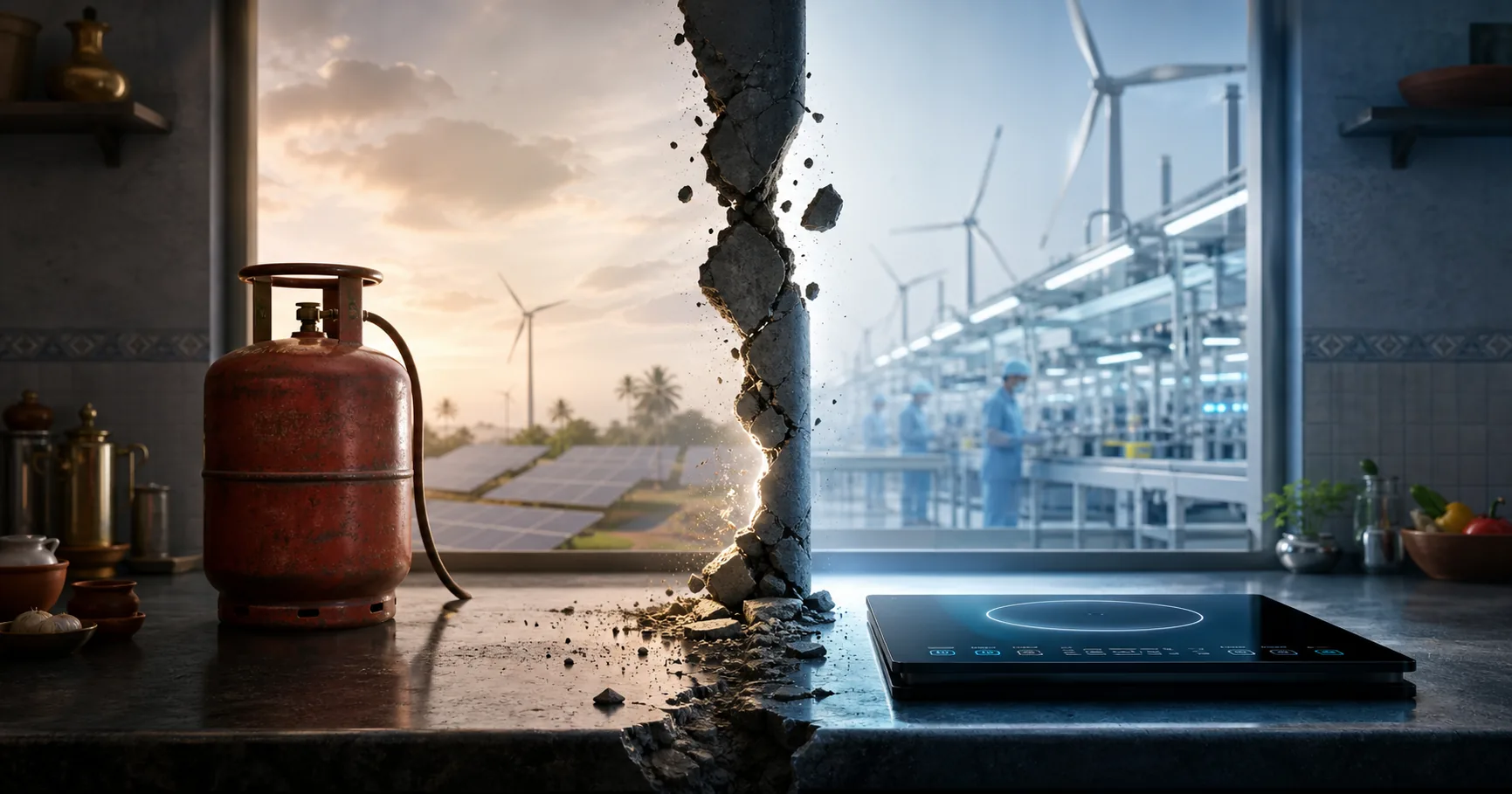
Tamil Nadu · May 2026
Why Vijay Anna Should Break His Poll Promise
The Annapoorani Super-6 scheme is good politics and bad economics. Here’s the trade Tamil Nadu should make instead — starting on day one.
The trade
- Stop: Six free LPG cylinders per household per year — a ₹10,000 cr/yr bill that grows every year the war drags on.
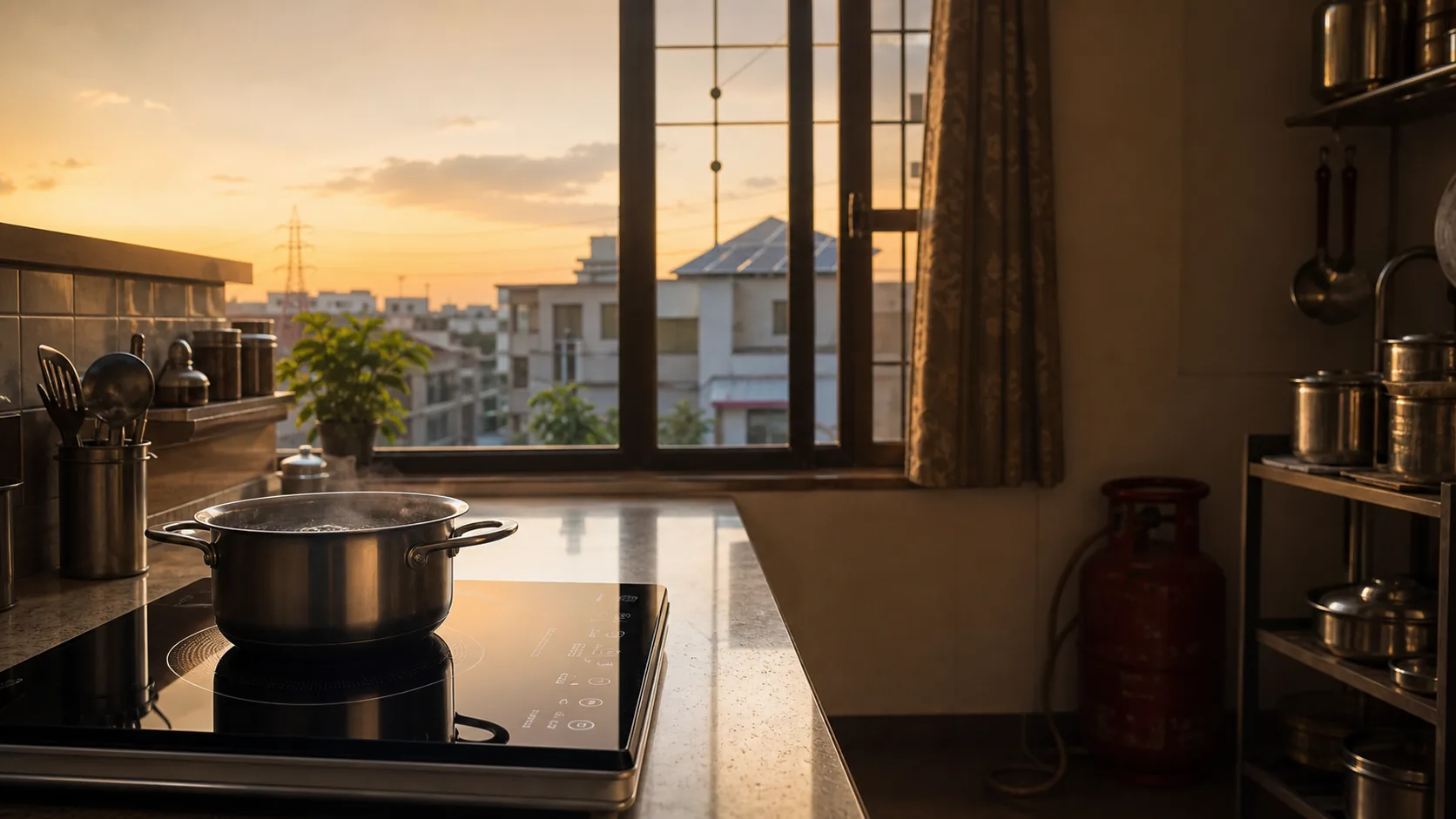
- Start: A free induction stove in every kitchen — ₹3,700 cr, once. The hardware costs less than two refills.
- Redirect: The cylinder budget into District Renewable Clusters — 15 GW solar, 5.7 GW wind, 11.4 GWh storage in a decade.
- Build: Tamil Nadu as the induction-manufacturing capital of the world. The next Foxconn-scale bet, on the next product.
- Rename: Annapoorani Super-6 → Annapoorani Safe-6. A stronger brand, because it promises a world, not a thing.
The Promise
On 4 May 2026, Tamilaga Vettri Kazhagam emerged as the single largest party in Tamil Nadu’s 17th Legislative Assembly with 108 seats and roughly 35% of the popular vote. Vijay won both Perambur and Tiruchirappalli East. A 59-year Dravidian duopoly is over.
The TVK manifesto is detailed, costed, and ambitious. Forty points across nine guarantee chapters. Two of those chapters define how Tamil Nadu cooks for the next decade:
- Annapoorani Super-6 Scheme — six free LPG cylinders per year per household
- 200 units of free electricity per month — for every household in Tamil Nadu
Vijay Anna should break the cylinder promise. He should break it and deliver more — a safer, cooler, cheaper, greener induction stove in every kitchen, the 200 units of free electricity already promised, and a Tamil Nadu that builds the green generation capacity to power all of it. That is the trade.
If you want the full national argument — why India should treat cooking electrification as energy security, not climate virtue — read the original Solar Pivot piece. What follows is the Tamil Nadu-specific version.
The Trap: What the LPG Price Is Actually Doing
Domestic LPG (the 14.2 kg household cylinder) has been held more or less flat. It rose ₹60 in March 2026 and has stayed at roughly ₹913–₹965 across metros since. The government is shielding 33 crore household consumers from the war. Politically necessary. Fiscally expensive — the cost of that shielding shows up as oil marketing company under-recoveries, the same ₹30,000 crore line item the original Solar Pivot piece flagged.
Commercial LPG (the 19 kg cylinder used by every restaurant, tea shop and tiffin centre) is being allowed to track the underlying market.
The commercial price is the canary. It is what domestic LPG would cost, today, if the government were not absorbing the gap. The domestic price is being held down by central government subsidy that will eventually have to be unwound — either as direct fiscal pressure on the centre, or as a slower, quieter pass-through to consumers, or as cuts to other welfare programmes.
The Annapoorani Super-6 headline cost will not stay at ₹10,000 crore for long. The BusinessToday estimate of ₹9,990 crore was calculated on a domestic cylinder cost of roughly ₹900. If the domestic price tracks even 50% of the way toward the underlying commercial cost over the next two years — which is a conservative assumption in a war environment — the same scheme costs ₹16,000 crore a year by 2028. By year five, possibly ₹20,000 crore. That is a budget line that breaks the state.
The promise was costed in a March 2026 world that no longer exists. Every month TVK delays acting on this, the bill grows.
The Leapfrog: Skip Gen 2, Go Straight to Gen 3
India did not build out a comprehensive landline network and then upgrade. India largely skipped landlines and went straight to mobile. In 1995 there were about 8 million phones in the country. Today there are over a billion. The capital that would have been wasted on copper trenches got deployed into towers and handsets. India is now the world’s second-largest smartphone market, the second-largest manufacturer, and Tamil Nadu builds the iPhones that go to America.
The same leapfrog is available for cooking energy.
What does that look like in policy terms?
Stop laying City Gas Distribution pipe. In March 2026, the central government laid the foundation for a ₹3,700 crore CGD network in the Nilgiris and Erode districts — PNG to nearly 9 lakh households. This is digging trenches to deliver imported molecules, in 2026, when the world is electrifying. It is the policy equivalent of installing copper landlines in 2005. Tamil Nadu should request the centre to redirect that ₹3,700 crore into rooftop solar and induction wiring instead.
Stop the LPG cylinder transfer programme. Replace it with a one-time induction transition.
Skip CNG for transport entirely. CNG as a transport fuel is being mothballed in markets like Norway and the Netherlands as battery EVs and electric two-wheelers take over. Tamil Nadu is building EVs and e-scooters today. VinFast committed $500 million to expand its TN plant. Ola and Ather are both anchored in Krishnagiri district, around Hosur — minutes from each other and squarely in TN. Building CNG fueling stations in 2026 is like opening CD stores in 2010.
The deepest argument for the leapfrog is generational. The last twenty years of Indian infrastructure investment were about catching up — laying networks the rich world built in the 1950s. The next twenty years are about jumping ahead. China has already done this on solar, on batteries, on EVs, on rare-earth processing. India can either build Gen 2 infrastructure that locks the country into another two decades of energy import dependency, or it can skip a generation. Tamil Nadu, of all states, has the technical capacity, the manufacturing base, and the political mandate to make the leap.
The Kitchen That Stops Being a Sweatbox
Every Tamil Nadu kitchen in May is a furnace with a 1,000-watt room heater running inside it.
Cooking on gas is hot. Cooking on induction is not.
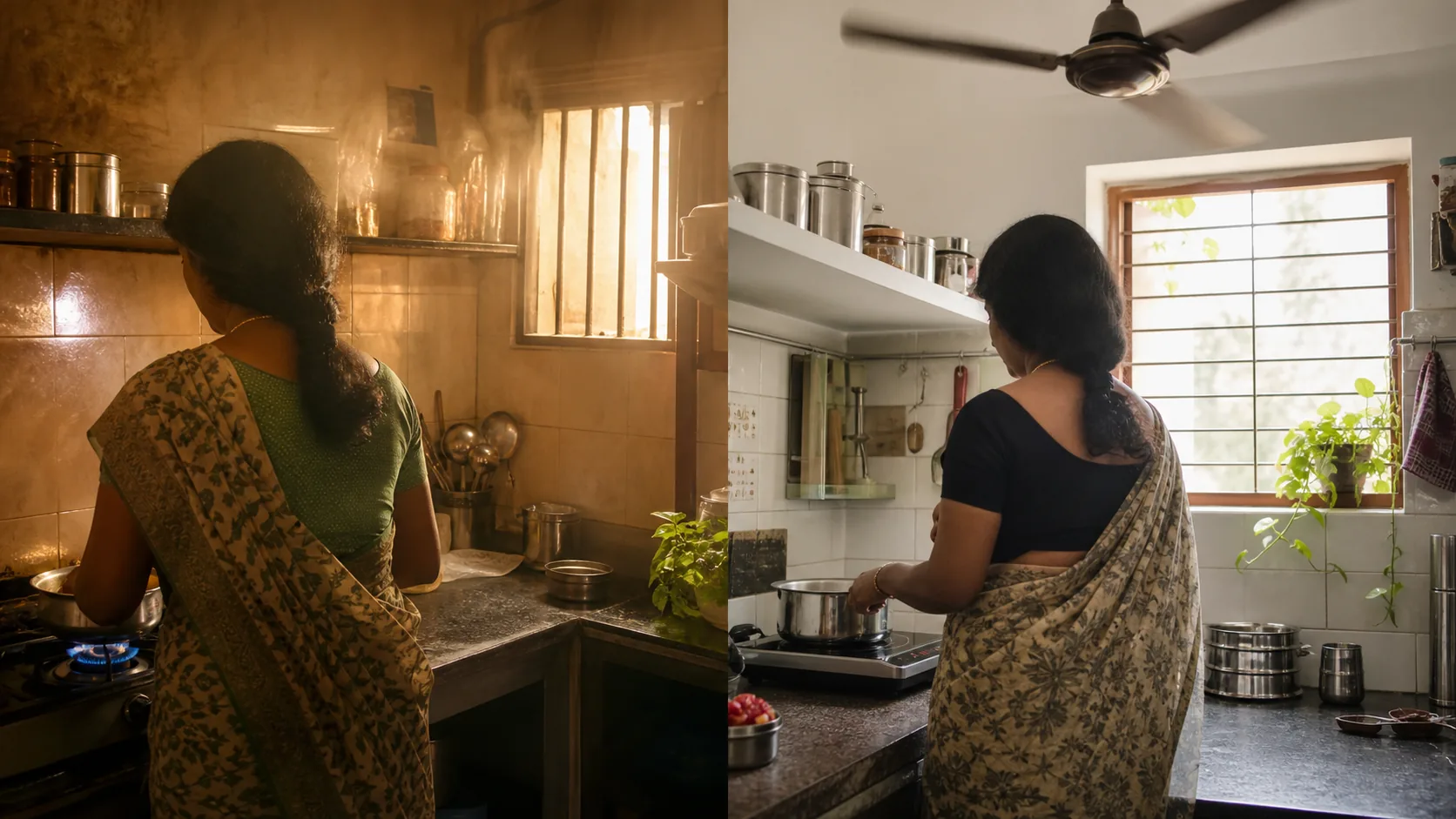
This is not a marginal difference. There are three things going on, and each of them matters.
1. The waste-heat math
A typical Indian household burns about 95 kg of LPG a year — roughly 6.7 cylinders, the standard PMUY ration. LPG has a calorific value of about 13.7 kWh per kg, so the household is burning roughly 1,300 kWh of fuel energy per year. At a gas burner’s 35% thermal efficiency, only about 455 kWh actually goes into the food. The remaining 845 kWh — almost two-thirds of the energy — gets dumped into the kitchen as waste heat.
A 100-square-foot Indian kitchen with typical ventilation, during active cooking on gas, runs 4–6°C above ambient room temperature. In Chennai’s May heat — when ambient kitchen temperature already touches 35–38°C — gas pushes the kitchen to 40–43°C. That is the temperature inside the room where your wife, your mother, your daughter is making your dinner. Every day.
On induction, the kitchen during cooking sits at roughly 0.5–1°C above ambient.
That’s just air temperature. The felt difference is larger. A gas stove radiates infrared heat directly at your face, your hands, your forearms, the moment you lean over a pot. Induction has no flame and the cooktop only heats where the vessel sits. The radiated-heat difference, in skin-perceived terms, is closer to 6–8°C cooler.
2. You can finally use a fan
You cannot run a fan in a flame kitchen. A ceiling fan above the stove blows the flame irregular, snuffs it out at low settings, throws ash and oil droplets across the room, and makes the whole exercise dangerous. A table fan pointed at the cook will blow out the burner. An open window during monsoon winds will do the same. Cross-ventilation through the kitchen door and an opposite window — the single most effective passive cooling technique in tropical Indian homes — is impossible the moment you light a flame on the hob.
So the gas-cooking woman cooks in a closed kitchen, in 42°C ambient heat, with no airflow. The fan stays off. The window stays mostly shut. She sweats through her saree, every meal, every day.
An induction kitchen has none of those constraints. Run the ceiling fan on max. Point a table fan directly at the cook. Throw open every window in the house. Set up cross-ventilation between the kitchen door and the living-room window. Nothing on the stovetop cares. The induction coil is electromagnetic — wind doesn’t disturb it any more than wind disturbs your phone charger.
This is the difference between a kitchen that traps heat and a kitchen that moves heat. Add active airflow on top of the 4–5°C waste-heat reduction, and the felt-temperature improvement during cooking is closer to 8–10°C lower in May. That is the difference between miserable and bearable.
3. The air the cook is breathing
The third thing is what the woman in that kitchen is breathing.
Burning LPG is a chemical reaction. The clean version is methane + propane + butane combining with oxygen to make CO₂ and water. The actual version, in any real-world kitchen, also produces:
- Nitrogen dioxide (NO₂) — a respiratory irritant. A 2013 meta-analysis of 41 studies found that children in homes with gas stoves had a 42% higher risk of current asthma and a 24% higher lifetime asthma risk.
- Benzene — a known carcinogen. A 2023 Stanford study published in Environmental Science & Technology measured gas burners emitting benzene at 10 to 25 times the rate of electric coil burners. Induction stoves emitted no detectable benzene at all.
- Formaldehyde — also a carcinogen, also produced by gas combustion.
- Carbon monoxide and PM2.5 — the standard fine-particulate and respiratory irritants.
A 2022 PSE Healthy Energy / Stanford analysis estimated that 12.7% of all childhood asthma cases in the US are attributable to gas stove use — roughly 200,000 children. A 2024 follow-up estimated long-term NO₂ exposure from gas stoves contributes to as many as 19,000 deaths per year in the US — about 40% of the death toll attributed to secondhand smoke.
These are US numbers, in US homes, with US ventilation standards. Indian kitchens are typically smaller, less ventilated, and used for much longer cooking sessions per day. A South Indian household preparing dosa, sambar and rice twice a day puts a flame in the room for 2–3 hours daily — far more than the average American household. The Indian numbers are almost certainly larger, not smaller.
What this means in a TN kitchen
Multiply the heat, the ventilation, and the air quality across 365 days. Across tens of millions of cooking sessions. Across the women who do most of that cooking.
The political party that puts a free induction stove in every home is:
- Cooling the kitchen by 4–5°C in air temperature, and 8–10°C in felt temperature once you can use a fan
- Eliminating measurable carcinogens from the air the cook breathes for 2–3 hours a day
- Removing open-flame risks: cylinder leaks, kitchen explosions, burnt sarees
- Making thirty-something-degree afternoons in May survivable for half the population
If TVK wants to keep the women’s vote it just won — and it just won big with women — this is the offer to make.
Two Cylinders Is the Whole Hardware Cost
A single-burner induction stove in India costs ₹2,000. A double-burner unit costs about ₹4,000. The good ones from Prestige, Bajaj, Pigeon, Philips are all in this range.
Two LPG cylinders in Chennai today cost ₹1,857 (₹928.50 × 2).
The induction stove costs less than two refills.
If every TN household just gets a free induction stove:
- Hardware cost: ₹2,000 per household, one-time = ₹3,700 crore total for 1.85 crore households
- Electricity cost for cooking: fits inside the existing 200-unit free electricity promise = ₹0 marginal cost to the household
- Even if a household keeps gas as backup for the occasional dosa or chapati, total LPG consumption falls by roughly 50% (induction handles all the high-energy stuff — boiling water, cooking rice, making sambar, the long-simmer dishes — and gas covers the rest)
- A 50% drop in LPG consumption means 3 cylinders/year instead of 6. Even without the cylinder subsidy, the household’s total cooking bill goes down
The grid can handle this. Tamil Nadu has 27 GW of installed renewables, 11 GW of wind on top of that, 11.7 GW of solar, and a peak demand of 20.7 GW today projected to 35.5 GW by 2034-35. Cooking electrification adds about 1.3 GW of average load and maybe 2–3 GW at evening peak — well within what the planned 12 GW expansion already covers, and with 70 kWh/month per household (well under the 200-unit free allotment), most households don’t even cross into paid territory.
The grid can take it. The household pays ₹0 marginal. The state’s only outlay is ₹3,700 crore one-time for the induction stove.
That is one-third of one year’s Annapoorani Super-6 budget. For forever of free cooking.
Day Zero: Pull the Bandaid Off
Distribute a free induction stove to every household in Tamil Nadu within six months.
The math:
- 1.85 crore induction stoves at ₹2,000 each = ₹3,700 crore
- Procured through bulk public tender (Foxconn, Salcomp, Pegatron-Tata, LG, Panasonic — all already operating in TN — would compete aggressively at this volume). At 1.85 crore units the unit price almost certainly falls below ₹2,000.
- Distributed via the existing PDS (ration card) network plus the Anganwadi system. TN has done this before — the state’s Amma canteens, free saree distribution, free bicycle programmes all use the same delivery infrastructure.
- Six months is the realistic timeline because TN’s domestic appliance manufacturing base is large enough that no imports are needed.
What about LPG? Do not strand the household. Three options the household can choose between:
1. Switch fully to induction
LPG cylinder subsidy stops; replaced by a credit toward the 200-unit free electricity (most households won’t even use it).
2. Use induction + gas
Keep the LPG connection. Use induction for everything except chapati and dosa. Gas consumption falls ~50%. The household pays for half as many cylinders out of pocket and is still better off than the original 6-free-cylinders deal.
3. Stay on gas
The household receives 4 free cylinders per year (down from 6) plus the induction stove sitting unused in the kitchen. Eventually they’ll switch.
In all three cases the state spends less, the household saves money, and the kitchen cools down.
The political framing that wins. “The government has given you a free induction stove that will cool your kitchen and reduce your cooking bill — and your free LPG is now on a glide path because you don’t need it any more.”
LPG is old news. Induction is new news. The longer Tamil Nadu pretends otherwise, the longer Tamil Nadu’s women cook in 42°C kitchens breathing benzene. There is no good version of dragging this out for five more years.
Rename the Scheme: Annapoorani Safe-6
The Annapoorani Super-6 brand should not die. It just needs to deliver a different “six.”
Call it Annapoorani Safe-6. Six things, every Tamil Nadu household gets:
Safe from explosions
No cylinder in the kitchen means no risk of cylinder burst — and 13–15 fewer LPG-cylinder deaths per year in TN.
Safe from carcinogens
No combustion means no benzene, no NO₂, no formaldehyde in the cook’s lungs.
Safe from heat
A 4–5°C cooler kitchen — and 8–10°C in felt terms once the fan is allowed to run.
Safe from the world
No more dependency on Hormuz, Saudi Aramco, or the Russian-oil tariff calculus.
Safe from the price spiral
No more exposure to the next ₹993-a-month commercial-cylinder hike.
Safe from the bill
Cooking energy is covered by TVK’s existing 200-unit free electricity promise.
How many lives does the first of these — explosion safety — actually save?
Tamil Nadu’s official LPG accident records (the Petroleum and Natural Gas Regulatory Board’s data, summarised in Factly’s December 2024 analysis) show 48 deaths in TN over the period FY 2021-22 to September 2024-25 — among the four worst-affected states in the country. That is roughly 13–15 deaths per year in Tamil Nadu directly attributable to LPG cylinder accidents, with hundreds more injuries and burns. NCRB’s “Accidental Deaths and Suicides” data, which counts cooking-gas-cylinder-and-stove burst incidents differently, runs significantly higher — about 15% of all home-fire deaths nationally are attributed to exploding cylinders and stoves.
A switch to induction prevents most of these deaths. Induction cooktops do not contain pressurised liquid fuel. They cannot explode. They cannot leak. They cannot ignite a saree from an invisible gas cloud above the floor. A child cannot turn on the wrong knob and slowly fill a closed kitchen with butane.
Safe-6 is a stronger political brand than Super-6. Super-6 promises a thing. Safe-6 promises a world.
Tamil Nadu, Induction Capital of the World
The clock is ticking on every gas stove on earth
There are roughly 2 billion gas stoves on Earth right now, plus another 2 billion-plus people still cooking on biomass and kerosene. Almost every one of those stoves has a clock ticking on it.
Climate clock
Every gas stove is a fossil-fuel-burning appliance. Net-zero pathways require their replacement.
Health clock
NO₂, benzene, formaldehyde, PM2.5. Once the science settles in policy, gas stoves go the way leaded petrol did.
Heat clock
Climate change is making every kitchen in the tropics hotter. The waste-heat-from-gas problem only grows. People will switch out of misery alone.
Speed clock
Modern induction is just better — five times faster than gas, more precise, safer, easier to clean. Once a household uses it for a month, no one goes back.
The inventory of gas stoves to be replaced runs into the billions — and the closer that inventory gets to its replacement deadline, the steeper the production ramp gets. Some unit-volume estimates have global induction shipments rising 10–20× over the next two decades. The frontier segment — battery-integrated induction — starts from essentially zero today. Every stove is a candidate.
The question is not whether this transition happens. It is who manufactures the 2 billion induction stoves on the other side.
Why that “who” should be Tamil Nadu
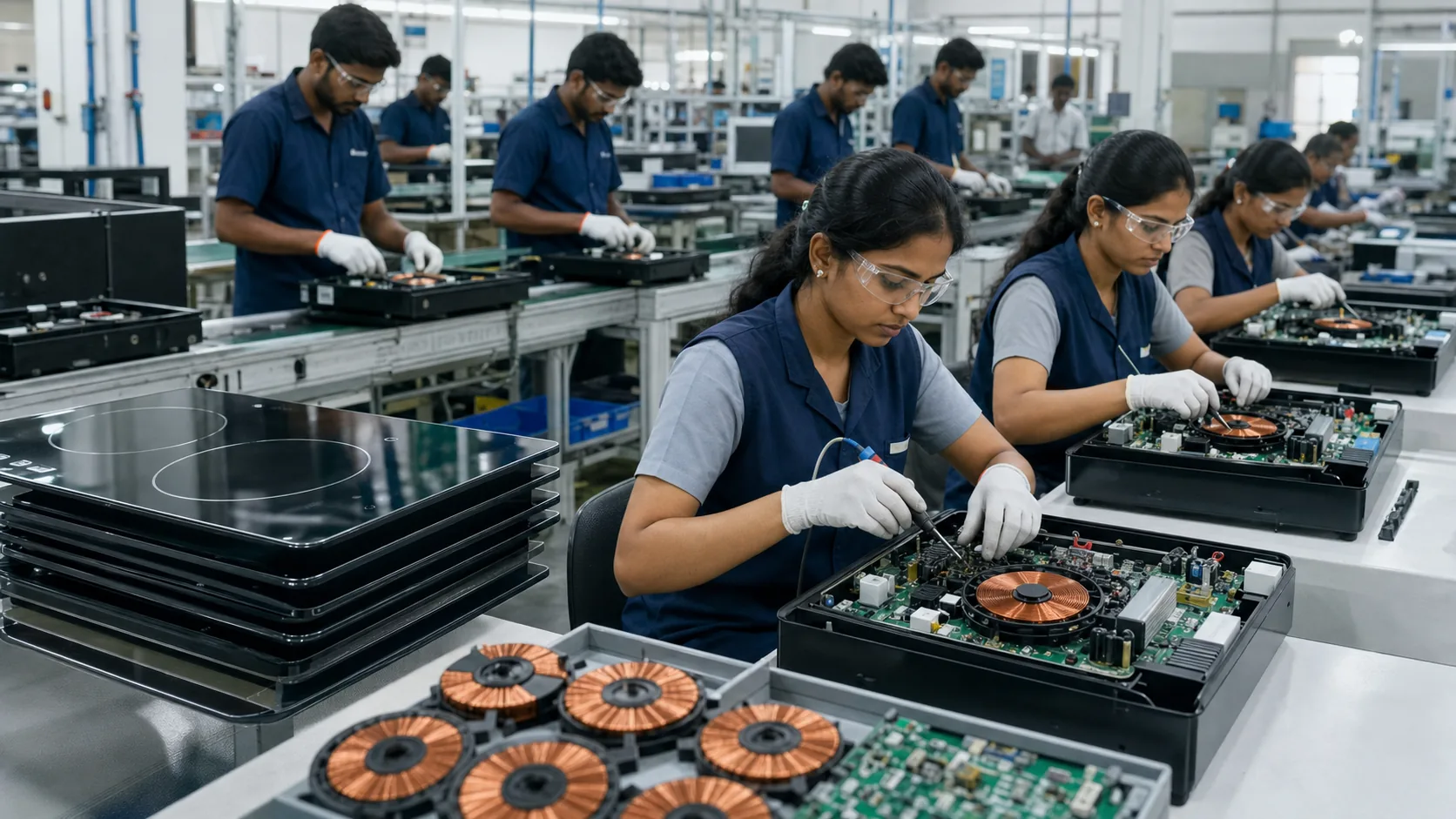
Tamil Nadu has a peculiar gift: when it decides to be the global capital of something, it actually becomes that.
It happened with automobiles. TN now produces about one in three cars made in India. Hyundai, Ford, BMW, Renault-Nissan, Daimler, Mitsubishi, Royal Enfield, TVS, Ashok Leyland, and now VinFast all have plants. The state is the “Detroit of South Asia,” not as marketing but as fact.
It is happening with cell phones. TN’s electronics exports hit $14.65 billion in FY 2025 — over 41% of India’s total. Foxconn’s Sriperumbudur facility produces a meaningful fraction of all iPhones made outside China. About 80% of the workforce at Foxconn’s Karnataka iPhone plant is women — a pattern Tamil Nadu has already matched at scale.
It can happen with induction stoves. And it should.
Here is why the analogy is exact, not loose:
- Induction is fundamentally a power-electronics product — an inverter, a copper coil, a control board, and a glass top. Tamil Nadu already has the deepest power-electronics supply chain in India.
- Induction needs precision metalwork (the coil) and glass (the cooktop). TN already has Corning (yes, that Corning) and a sophisticated metals ecosystem in Hosur and Sriperumbudur.
- Induction needs assembly at scale. The state has the labour, the dorms, the SEZs, the port access (Chennai, Ennore, Tuticorin), and the Naan Mudhalvan skilling programme already running.
- Induction needs an anchor domestic market. India’s 33 crore LPG-using households are that market. Tamil Nadu’s 1.85 crore households alone are larger than most countries.
- Induction needs export competitiveness. The same labour cost structure that drives iPhone exports works for induction. South-East Asia, Middle East, and Africa are the natural export markets.
Why is Tamil Nadu’s youth being asked to inherit a 1950s-era LPG distribution system, when their parents’ generation built the world’s iPhone factory?
The auto cluster of the 2000s was the right bet for that decade. The Foxconn cluster of the 2020s was the right bet for this decade. The induction cluster of the 2030s is the obvious next bet.
The 10% target
Global induction cooktop unit shipments today are roughly 30–40 million per year, almost entirely manufactured in China. Twenty years out, with the full clock-ticking-on-every-stove transition playing out, that number plausibly hits 200–400 million units a year.
Tamil Nadu should aim at 10% of that flow within five years — roughly 5–10 million induction units per year, mostly for export. That is the same scale, give or take, as the iPhone manufacturing footprint the state has already built.
What does this mean as an actual programme? Three things:
- A Tamil Nadu Induction Manufacturing Mission with a ten-year horizon and a single-point owner — along the lines of the Foxconn Desk that now sits inside Guidance Tamil Nadu. State-level PLI-style incentives that stack on top of whatever the centre offers.
- A public procurement guarantee. The Day Zero programme is itself this: 1.85 crore induction units bought in six months guarantees domestic anchor demand. Every government office, school, hostel, hospital, mid-day-meal kitchen and PSU canteen in TN buys only TN-made induction over a five-year ramp.
- Export market support through the TN Export Promotion Bureau, specifically aimed at Sri Lanka, Bangladesh, Nepal, the GCC and East Africa.
This — not free cylinders — is the offer to make to a generation that voted, against 59 years of habit, for change.
Why Next-Gen Induction Is Worth Building At, Not Just Selling Into
Two American startups, Channing Street Copper (the “Charlie” range) and Impulse Labs, have begun shipping battery-integrated induction stoves in the United States. A Charlie includes a 5 kWh battery; an Impulse cooktop includes a 3 kWh battery. The implications are striking:
- They plug into a standard 15A socket — no expensive electrical upgrade required. This solves the single biggest barrier to induction adoption in older Indian homes.
- They deliver up to 10,000 watts per burner — five times the power of gas, three times the power of conventional induction. Boil water in under 40 seconds. Fry the fish. Cook the paruppu.
- They keep cooking through a power cut — three to five meals per charge. In a state with frequent grid outages, this is not a luxury feature; it is the answer to the most common objection to electric cooking.
- They can act as distributed grid resources — charging when solar is abundant, discharging when the grid is stressed.
That last point is enormous for India. The biggest constraint on Indian rooftop solar is what to do with surplus midday generation. Battery-equipped appliances are a structural answer. 1.85 crore households × 3 kWh = 55.5 GWh of dispatchable storage in Tamil Nadu alone — twelve times the Vellimalai pumped storage project, hidden inside everyone’s kitchen.
Tamil Nadu can either import these products in five years at frontier prices, or it can build them here, sell them to India, and export them to the world.
The Tamil Nadu Electric Cooking Hub — at Madurai
Cooking is one of the few household activities that has not really been redesigned for the electric era. Indian kitchens evolved around the gas burner. Tamil cuisine — dosai, idiyappam, kuzhambu, biryani, the entire restaurant kadai-and-tava economy — has co-evolved with high-flame, high-throughput gas. Most existing induction stoves are imported designs sold at imported prices, calibrated for European stews, not South Indian kadai and tava work.
Tamil Nadu should stand up an Electric Cooking Hub in Madurai, anchored at Thiagarajar College of Engineering (TCE), with NIT Tiruchirappalli and CSIR-CECRI Karaikudi as research partners.
Cuisine identity
One of India’s most cooking-famous cities — Madurai non-veg, jigarthanda, kari dosa, kothu parotta. You set up a centre that defines “good” induction where the cooks are.
Institutional fit
TCE: NAAC A++, founded by the Chettiar industrial family, NIRF top-150 engineering, AICTE-CII Best Industry Linkage award, MuthirAI Tamil-AI centre, AWS/IBM/Bentley CoEs.
Research triangle
CSIR-CECRI Karaikudi (India’s premier electrochemistry/battery lab) is 95 km away. NIT Trichy is 130 km north.
Political fit
TVK held its second political conference in Madurai in August 2025. Anchoring a flagship industrial programme there sends the right signal — change goes to the regions.
Three things sit underneath the Hub:
A standards body. Define what “Tamil Nadu certified” induction means — for restaurants, for street vendors, for households. Standards that account for thermal stability under a kadai’s irregular base, pulse power for tossing fried rice, low-and-slow setting for kanji or mutton kozhambu, burst boiling for sambar. The same way ISI standards lifted Indian electronics, “TN-Cook” standards can lift Indian induction.
A consumer and restaurant testing lab. Partnering TCE (mechanical and electrical), NIT Trichy (power electronics, controls), and CSIR-CECRI (batteries and electrochemistry), this becomes the place where every induction product sold in India gets tested for Tamil cooking. Make the data public.
An annual prize — the Annapoorani Innovation Prize. ₹50 crore a year, three categories:
- ₹20 crore — best Indian-designed household induction stove
- ₹20 crore — best commercial induction range for restaurants and street food
- ₹10 crore — best battery-integrated induction appliance
A ₹50 crore annual prize is 0.5% of the cylinder scheme. For that money, you get a permanent industry.
The East Asia Card
Tamil Nadu’s diplomatic and industrial relationships with East Asia are unusually deep, often underrated, and exactly the right asset for this project.
Japan
JICA has been one of TN’s most consistent infrastructure lenders for two decades. Concessional loans typically come at 0.4–1.5% interest with 30–40 year tenors — cheaper than the centre can borrow domestically. Panasonic, Hitachi, Toshiba, Mitsubishi all build induction at scale. A JV is on the table the day the state asks.
Korea
Hyundai’s Sriperumbudur plant is the second-oldest Korean industrial anchor in India after Maruti. Samsung, LG and SK manufacture in TN or AP. LG is a top-three induction manufacturer globally — they should be the anchor partner for a TN-Korea induction JV.
Taiwan
Foxconn alone has committed ₹15,000 crore to TN, runs five iPhone factories, and has set up a Foxconn Desk at Guidance Tamil Nadu. Induction stoves are fundamentally a power-electronics product. The same supply chain that builds chargers builds induction. The Taiwanese ODM playbook applied to induction would crush global price points.
China
Politically delicate, technologically inevitable. China builds 80%+ of the world’s induction cooktops today — Midea, Joyoung, Supor, Galanz. A Chinese JV for induction manufacturing in TN, structured carefully, is not impossible — and will be far cheaper than going alone.
What does deployment look like, concretely?
- A Tamil Nadu Cooking Electrification Facility — a single sovereign-backed financing vehicle that pools ₹30,000–₹50,000 crore over five years from JICA, Korea EXIM, the World Bank, and ADB.
- A Joint Venture Induction Manufacturing Cluster anchored at SIPCOT Madurai or Krishnagiri, with one Japanese, one Korean, and one Taiwanese OEM, plus state equity participation through SIPCOT.
- A technology transfer agreement specifically for inverter-grade IGBTs, induction coil winding, and power-control firmware — the three places where Indian induction lags global frontier today.
None of this is exotic. This is the same playbook that brought Hyundai to Sriperumbudur in 1996 and Foxconn in 2017. It just needs to be aimed at induction.
The Grid Question: One Renewable Cluster Per District
If you electrify cooking for 1.85 crore households, what about the grid?
The honest answer is: the grid can already take it, but should be reinforced anyway.
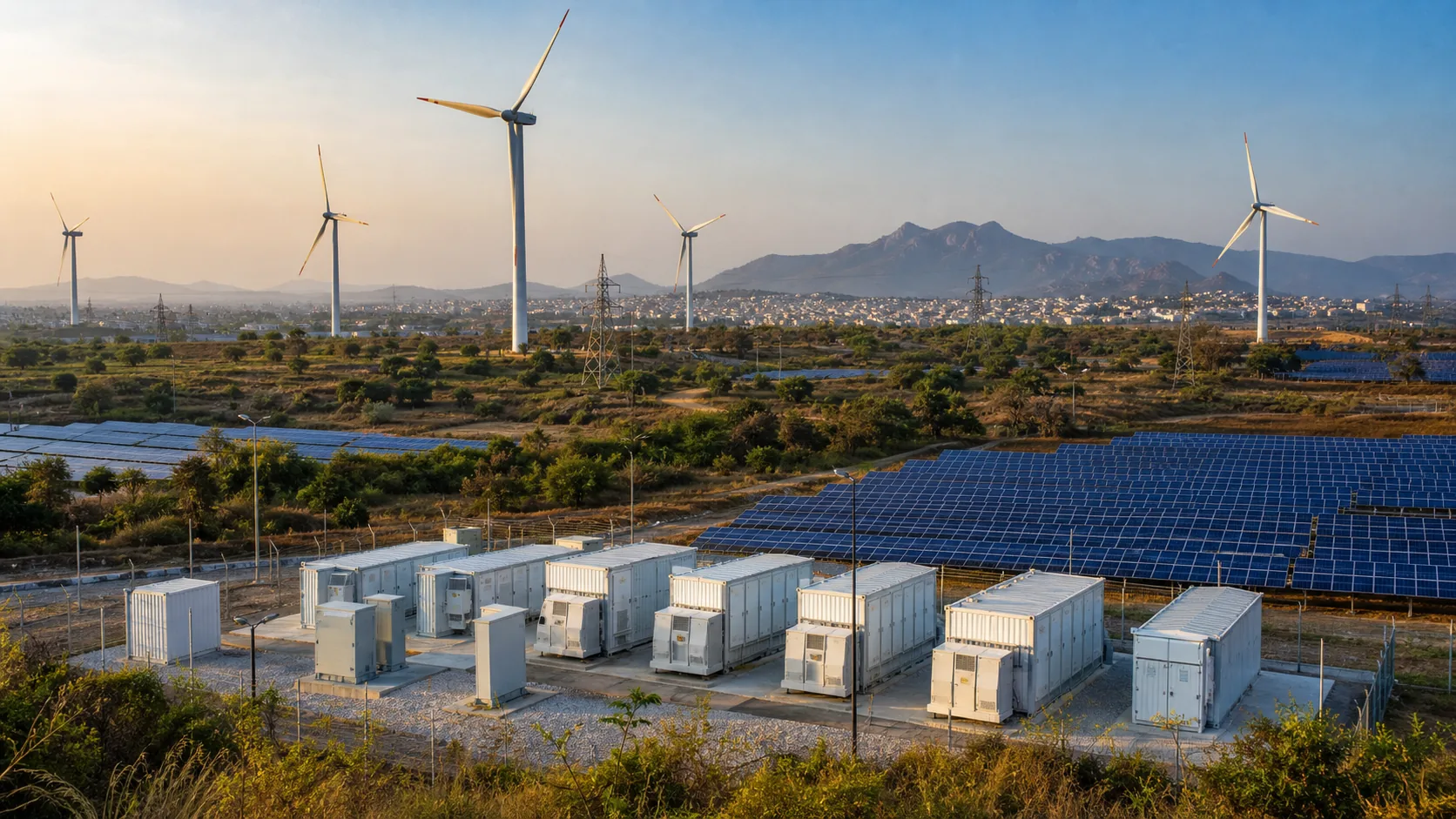
Cooking electrification adds roughly 1.3 GW of average load and 2–3 GW at the evening peak, on top of TN’s current 20.7 GW peak. That fits inside the 12 GW renewables expansion the state has already announced. With most households drawing 70 kWh/month for cooking — well under the 200-unit free allotment — the demand is real but bounded.
But why stop there. The Annapoorani Super-6 budget — ₹10,000 crore per year — does something the cylinder scheme can never do: it pays for the supply.
Tamil Nadu has 38 districts. Allocate ₹250 crore per district per year to a standardised District Renewable Cluster: utility-scale solar + wind + battery, sized to the district’s load. ₹250 crore × 38 districts = ₹9,500 crore. That is the entire Annapoorani Super-6 budget, with ₹500 crore left over for transmission and the Cooking Hub.
This is not a hypothesis. The state is already doing this in pieces. There is a 500 MW / 1,000 MWh BESS project under VGF with commissioning targeted for May 2027. A 1.1 GW pumped storage project at Vellimalai is in advanced execution. The 500 MW Kundah pumped storage was due for commissioning by April 2026. The 130 MW solar-wind hybrid at Tuticorin (NCL Industries) was approved in April 2026. The pieces exist; they are all being assembled by private capital and central VGF. What’s missing is a state-level commitment to standardise and industrialise this at the district level, paid for by the money currently earmarked to import LPG.
The District Renewable Cluster also re-anchors energy security at the district level. When a foreign war chokes Hormuz, the panchayat in Coimbatore West shouldn’t care. When an OPEC contract price spikes, the kitchen in Nagapattinam shouldn’t care. Each district producing meaningful renewable power, with battery storage to ride through evenings, is what energy sovereignty actually looks like at the only scale that matters: where people live.
The Math
Same ₹10,000 crore a year. Two completely different outcomes.
| Year 1 | Year 5 | Year 10 | |
|---|---|---|---|
| Annual exchequer cost | ₹10,000 cr | ₹16,650 cr | ₹20,000 cr |
| Cumulative cost | ₹10,000 cr | ₹70,000 cr | ₹1,75,000 cr |
| New productive assets | None | None | None |
| TN manufacturing jobs | Zero | Zero | Zero |
| Lifetime household savings | ₹0 | ₹0 | ₹0 |
| Import dependency | Worse | Worse | Worse |
| Year 1 | Year 5 | Year 10 | |
|---|---|---|---|
| Annual outlay | ₹10,000 cr | ₹9,650 cr | ₹9,650 cr |
| New solar capacity | 600 MW | 7.5 GW | 15 GW |
| New wind capacity | 230 MW | 2.85 GW | 5.7 GW |
| New BESS storage | 460 MWh | 5.7 GWh | 11.4 GWh |
| TN manufacturing jobs (cumulative) | 15,000 | 80,000 | 200,000+ |
| Household savings (cumulative) | ₹4,000 cr | ₹40,000 cr | ₹1,20,000 cr+ |
| Import bill avoided | ₹2,200 cr | ₹15,000 cr | ₹40,000 cr+ |
| Cylinder-explosion deaths prevented | 13–15 | 65–75 | 130–150 |
The same ₹10,000 crore a year, redirected, builds 15 GW of new solar, 5.7 GW of wind, and over 11 GWh of battery storage in a decade. It seeds a state-anchored induction manufacturing industry. It generates two lakh jobs. It eliminates ₹40,000 crore in cumulative LPG imports. It prevents an estimated 130–150 cylinder-explosion deaths over the decade. It leaves the state with an asset base that compounds.
The original promise leaves the state with nothing — and a fiscal hole that will get bigger every year the war drags on.
Conclusion
The Annapoorani Super-6 promise, as written, does the easiest possible thing. It transfers cash to households, cylinder by cylinder. It is well-intentioned.
There is a version of the next decade where Tamil Nadu, in 2032, has:
- Phased out LPG dependency entirely
- Built 15 GW of new utility renewables, district by district
- Become India’s induction manufacturing capital, exporting millions of units a year
- Served as Asia’s lab for next-generation battery-integrated cooking technology
- Dramatically reduced indoor air pollution and kitchen heat
- Saved 130–150 lives from cylinder accidents
- Saved households thousands of crores in energy bills, every year, forever
That version costs the same as the cylinder version, in year one. By year three, the alternative is cheaper. By year ten, it’s a different state.
It just requires one act of political courage on day one.
Tamil Nadu voted for change. We want big change — change that leapfrogs. Annapoorani Safe-6 is the change Tamil Nadu needs.
Tamil Nadu has done bigger things. Wind banking in 1990. The auto cluster of the 2000s. The Foxconn pivot of the 2020s. Each required somebody to break with the obvious thing and aim at a harder thing.
Annapoorani is the goddess of food. The right offering is not six imported cylinders. It is a kitchen that does not depend on any imported molecule at all.
Break the promise, Vijay Anna. Make a better one. Day one.
A Tamil Nadu sequel to India’s Solar Pivot: Why the Hormuz Crisis Should Permanently Change How India Cooks, March 2026. Interactive cooking-electrification calculator: prasannais.com/electrify-cooking.
FAQ
Will TVK’s Annapoorani Super-6 scheme really cost ₹10,000 crore per year?
That is the BusinessToday and Indian Express estimate based on 1.85 crore eligible households × 6 cylinders × roughly ₹900 per cylinder. The figure assumes the central government continues to absorb most of the import-cost gap as it does today. If the LPG price tracks even partially toward the underlying commercial-cylinder rate (which has risen 79% in two months), the scheme cost realistically rises to ₹16,000–20,000 crore per year by 2028.
How much electricity does induction cooking actually use per household in India?
A typical Tamil Nadu household needs about 70 kWh per month for cooking on induction — roughly 850 kWh per year. This sits comfortably within TVK’s 200-unit free-electricity promise. About 35% of the free allotment goes to cooking; the remaining 65% covers fans, lights, refrigerator, TV, and chargers.
Is induction cooking cheaper than LPG in India?
Yes, even before the free electricity. A single-burner induction stove costs ₹2,000 — less than the cost of two LPG cylinders in Chennai (₹1,857). Per-unit cooking cost on induction at TN’s domestic tariff is also lower than LPG once the stove is paid for, because induction’s 85% efficiency wastes far less energy than LPG’s 35%.
Will the Tamil Nadu grid handle 1.85 crore households cooking on electricity?
Yes. The added load is roughly 1.3 GW average and 2–3 GW at evening peak, against TN’s 20.7 GW peak today and a planned expansion to 35.5 GW by 2034-35. The state already has 27 GW of renewable capacity and a 500 MW/1,000 MWh BESS coming online in 2026, plus pumped storage at Kundah (500 MW) and Vellimalai (1.1 GW). The induction load fits inside the planned expansion comfortably.
Is induction cooking safer than gas?
Induction cooktops cannot explode. They have no pressurised liquid fuel, no flame, no leak risk, and no carbon-monoxide hazard. Tamil Nadu officially recorded 48 LPG cylinder deaths between FY 2021-22 and September 2024-25 — among the four worst-affected states nationally. NCRB ADSI data attributes about a sixth of all home-fire deaths in India to exploding cooking-gas cylinders and stoves. A full switch to induction in TN would prevent an estimated 13–15 deaths per year and hundreds of injuries.
Are gas stoves really linked to cancer and asthma?
Several peer-reviewed studies show gas stoves measurably release NO₂, benzene, formaldehyde, CO and PM2.5 into kitchen air, while induction releases none. A 2013 meta-analysis of 41 studies found 42% higher current asthma risk and 24% higher lifetime risk for children in homes with gas stoves. A 2023 Stanford study measured benzene from gas burners at 10–25× electric coil rates; induction emitted no detectable benzene. A 2022 PSE Healthy Energy / Stanford analysis attributed 12.7% of US childhood asthma cases to gas stove use. Some studies dispute the asthma causal claim, but the emissions themselves are not in dispute — and benzene and formaldehyde are classified carcinogens with no safe exposure threshold.
How much hotter is a kitchen with a gas stove compared to induction?
Air temperature: roughly 4–5°C hotter on gas during active cooking. Felt temperature (including radiated infrared from the open flame): closer to 6–8°C hotter. Add the fact that you can’t run a fan or open windows over a gas flame — but you can with induction — and the felt-temperature difference goes to 8–10°C in May. This is the single most under-appreciated benefit of induction in the Indian climate.
Who manufactures induction stoves today, and where could Tamil Nadu fit in?
About 80%+ of global induction cooktop production happens in China today (Midea, Joyoung, Supor, Galanz). Korea (LG, Samsung) and Japan (Panasonic, Hitachi, Toshiba, Mitsubishi) hold most of the rest. India’s domestic share is small. With 1.85 crore units of domestic anchor demand from TN alone, plus existing power-electronics infrastructure (Foxconn, Pegatron-Tata, Salcomp, Jabil), Tamil Nadu can credibly target 5–10 million induction units per year within five years — mostly for export to South-East Asia, the Middle East, and Africa.
How big is the global induction stove market really going to get?
Conservative analyst forecasts put global induction cooktop revenue at $40–50 billion by 2030–2035. The underlying inventory is much bigger: roughly 2 billion gas stoves on Earth today, plus another 2 billion-plus people still cooking on biomass and kerosene. Almost all of that base needs to transition over the next 20–30 years for some combination of climate, health, kitchen-heat, and speed-of-cooking reasons. The unit-shipment trajectory is therefore likely 10–20× current rates by 2040, with the next-generation (battery-integrated) segment growing from essentially zero today.
Why locate the Electric Cooking Hub in Madurai instead of Chennai or Coimbatore?
Three reasons. (1) Cuisine identity — Madurai is one of the most cooking-famous cities in India and the natural place to define "good" induction standards for Tamil cooking. (2) Strong institutional anchor — Thiagarajar College of Engineering (TCE) is government-aided autonomous, NAAC A++, with strong electrical/mechanical/CSE departments and the AICTE-CII Best Industry Linkage Award. CSIR-CECRI Karaikudi (95 km away) is India’s premier electrochemistry/battery lab. NIT Trichy (130 km) is one of India’s top engineering institutions. (3) Political fit — TVK held its second political conference in Madurai in August 2025; anchoring a flagship industrial programme there sends the right signal — change goes to the regions, not just the metros.
Would the proposal really require Vijay Anna to break a promise?
Technically, yes — the cylinder transfer would not happen as advertised. Politically, the proposal allows a face-saving rebrand: Annapoorani Super-6 becomes Annapoorani Safe-6, with six different things every household gets — safety from explosions, from carcinogens, from kitchen heat, from import dependency, from the price spiral, and from the bill. It is a stronger political brand than the original, because it promises a world, not a thing. And the induction stove can still be distributed in six months — faster than the cylinder rollout would have happened.
What about households that don’t want to give up gas entirely?
They don’t have to. The proposal gives every household a free induction stove; the household can choose how to use it. Most will land naturally on induction-for-most-things-plus-gas-for-dosa-and-chapati, which cuts LPG consumption by about 50% — meaning the household is still better off than under the original 6-free-cylinder deal even if they pay for the remaining cylinders themselves. A small number will keep gas as primary; most of those will switch within a year once they experience the kitchen-temperature difference.
What does this mean for India beyond Tamil Nadu?
If TN runs this play successfully, every other Indian state with comparable LPG dependency (Karnataka, Maharashtra, Gujarat, Punjab) will copy it within 18–24 months. India’s full LPG import bill — ₹1.3 lakh crore a year, 90% of which transits the Strait of Hormuz — is the same problem at national scale. The original Solar Pivot piece argued for the national version of this case. The Tamil Nadu pilot is the proof.
Sources & Notes
- TVK 2026 Tamil Nadu election results: 108 seats, 35% vote share, 59-year Dravidian dominance ended (Election Commission of India; Wikipedia 2026 TN Legislative Assembly election; Variety, 5 May 2026)
- TVK manifesto: ₹2,500/month for women heads of household, 6 free LPG cylinders/year (Annapoorani Super-6), 200 units free electricity/month, 8 g gold for brides, ₹25 lakh family health insurance (Logical Indian; Deccan Chronicle; Daily Pioneer)
- Annapoorani Super-6 cost estimate: 1.85 crore households × 6 cylinders × ~₹900 = ₹9,990 crore/year (BusinessToday, 6 May 2026; Indian Express)
- Domestic LPG cylinder price (Chennai), May 2026: ₹928.50 per 14.2 kg (Goodreturns)
- Commercial 19 kg cylinder trajectory in Delhi: ₹1,716 → ₹2,031 → ₹3,071.50 (March-April-May 2026); single-month hike of ₹993 was the largest in history; Kolkata saw ₹1,147 May hike (Goodreturns; Logical Indian; BusinessToday TV)
- LPG cylinder accidents in Tamil Nadu: 169 accidents, 48 fatalities FY 2021-22 to Sept 2024-25 — fourth worst state nationally (Factly analysis of OMC data, December 2024). NCRB ADSI: ~1/6 of home-fire deaths attributed to cooking-gas cylinder/stove burst
- Tamil Nadu installed renewable capacity: ~27 GW including ~12 GW wind and ~11.7 GW solar (Renewable Watch; SaurEnergy; BioEnergy Times)
- Tamil Nadu BESS pipeline: 500 MW/1,000 MWh project (commercial ops Dec 2026); 375 MW/1,500 MWh and 30 MW/90 MWh hybrid systems with central VGF (Down To Earth)
- Pumped storage: 500 MW Kundah (April 2026), 1.1 GW Vellimalai, 2.4 GW Aliyar in pipeline (Down To Earth)
- TN peak demand forecast: 35.5 GW by 2034-35, up from ~20.7 GW today (Down To Earth)
- Tamil Nadu electronics exports FY 2025: $14.65 billion, 41%+ of India’s total; Foxconn iPhone manufacturing scaling to 25–30 M units/yr (India Briefing; Outlook Business; The Week; BusinessToday)
- Battery-integrated induction stoves: Channing Street Copper "Charlie" (5 kWh battery, 120 V plug); Impulse Labs cooktop (3 kWh battery, up to 10,000 W per burner) (Volts; Fast Company; Impulse Labs)
- Gas-stove childhood asthma: Lin, Brunekreef, Gehring meta-analysis of 41 studies, Int J Epidemiology 2013 (42% higher current asthma risk; 24% lifetime)
- Gas-stove benzene emissions: Kashtan et al., Environmental Science & Technology 2023 (10–25× electric coil; induction emitted no detectable benzene)
- US childhood-asthma attributable fraction: Gruenwald et al., Int J Environmental Research and Public Health 2022 (12.7% of US childhood asthma attributable to gas stoves)
- NO₂ exposure mortality: Kashtan et al., Stanford 2024 (long-term gas-stove NO₂ exposure linked to ~19,000 US deaths/yr)
- Counter-claim: L.A. Cox, Global Epidemiology 2023, questions causal validity of asthma attribution; emission measurements themselves not in dispute
- TCE Madurai: NIRF 101-150 engineering, NAAC A++, founded 1957 by Karumuttu Thiagarajan Chettiar; AICTE-CII Best Industry Linkage Award; MuthirAI Tamil-AI centre
- India imports 60% of LPG; 90% of imports transit Hormuz (PIB; PPAC)
- JICA concessional loan terms (0.4–1.5%, 30–40 year tenors): JICA India operations standard terms
- City Gas Distribution foundation in Nilgiris/Erode, March 2026: ₹3,700 crore, 9 lakh PNG connections (PIB; Edunovations)