A public argument for public assembly
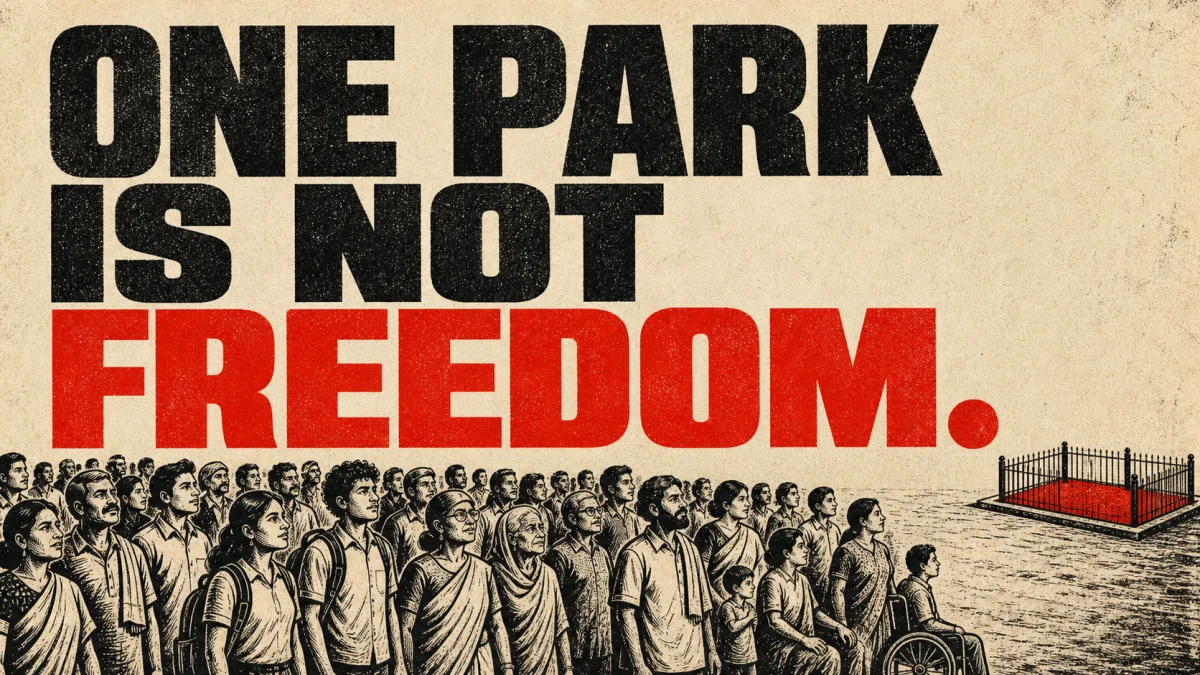
One park
is not
freedom.
Democracy requires the right to assemble. Freedom requires the right to protest. Neither exists if police can confine both to one address.
Is the Constitution of India legitimate only inside Freedom Park?
The Constitution is not geographically rationed. Our rights exist in every neighbourhood, city and state—not only in one police-approved park.
01 / THE DEMAND
A right you can exercise only where police send you is a permission.
Assembly is how people without money, connections or a private auditorium find one another. A tenant, a parent, a worker or a bus passenger can stand beside others and make an issue impossible to ignore. That is exactly why the state tries to license it.
Peaceful speech and assembly must be presumptively lawful in streets, parks, squares and other genuinely public spaces.
Regulation must manage a demonstrated problem—traffic at a stated hour, emergency access, noise, capacity or safety—with the least restrictive condition that works.
Peaceful assembly must require notice, not prior permission. Large events need coordination. They do not need an executive veto over whether citizens may speak together.
Commercial occupation can be licensed separately. Selling, construction and exclusive commercial use are not constitutional equivalents of citizens speaking together.
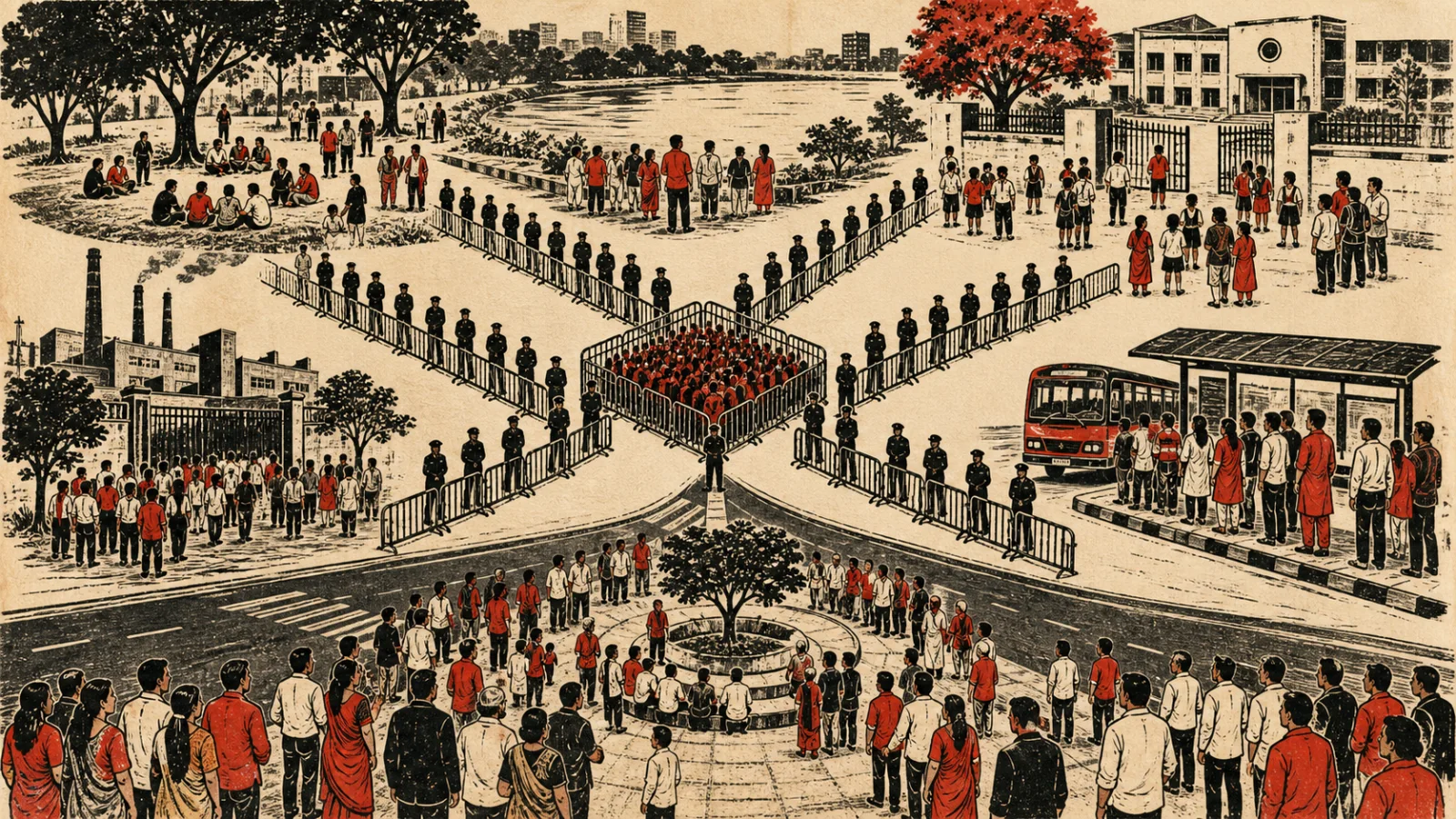
We are not claiming a right to violence or to block a carriageway indefinitely. We are claiming that keeping one road open cannot silence every other road, park and square.
A government may regulate the exercise of a right. It may not redesign the right until only a harmless ritual remains.
02 / THE BENGALURU SPECIMEN
1.3 crore people. One approved protest address.
The Licensing and Regulation of Protests, Demonstrations and Protest Marches (Bengaluru City) Order, 2021, brought into operation in early 2022, was made under section 31(1)(o) of the Karnataka Police Act, 1963. The state told the Karnataka High Court that protests, marches and dharnas would be permitted only at Freedom Park.
On 1 August 2022, in a traffic-related suo motu PIL, the High Court recorded that position and directed the authorities to enforce the 2021 Order “in letter and spirit.” The short disposal order does not conduct a visible Article 19 proportionality analysis. It arose after one rush-hour protest caused severe congestion; the resulting regime applies in advance to everyone, everywhere in the city.
Bengaluru’s civic administration puts the population it serves at more than 1.3 crore. More than 1.3 crore people cannot be confined to one protest site in central Bengaluru.
- Enabling provision
- Karnataka Police Act §31(1)(o)
- Executive instrument
- Bengaluru Protest Order, 2021
- Court proceeding
- Suo-Motu W.P. 5781/2021
- Default result
- Freedom Park or police grace
“Protests, marches and dharanas shall be permitted to be held only at the Freedom Park.” Karnataka High Court’s record of the State’s position, paragraph 4
The order and police practice collapse radically different activity into one suspect category: five neighbours talking under a tree; a silent vigil on a footpath; a May Day march; residents walking beside the flyover they oppose; an indefinite occupation of a major road. Only the last involves sustained occupation of a road. The others can be managed through ordinary rules for numbers, time, noise and safety.
PLACE IS PART OF THE SPEECH
A Bellandur issue belongs in Bellandur.
Local protest brings an issue to the people who live with it, the officials responsible for it and the public whose support can change it. Removing that encounter removes much of the democratic value.
If a Bellandur issue must move to Freedom Park, must a Mysuru issue move there too? If one approved ground is enough for a state, why not make every Indian protest at Jantar Mantar?
Is there no freedom of speech—or right to protest—in the rest of Bengaluru?
03 / THE CONSTITUTION
Public order is a constitutional ground. Police convenience is not.
Articles 19(2) and 19(3) permit only reasonable restrictions tied to specified constitutional grounds. The government must identify the permitted ground, the facts that engage it and why a narrower condition will not work.
ARTICLE 19(1)(a)
Speak
The freedom of speech and expression. A protest is speech made visible; a meeting to plan one is speech before it takes the street.
ARTICLE 19(1)(b)
Assemble
The right to assemble peaceably and without arms. The text protects an assembly—not merely an assembly at the one address chosen by police.
ARTICLE 14
Equal law
State action cannot be arbitrary. Unguided permission, selective exceptions and unexplained refusals turn a fundamental right into official favour.
ARTICLE 13 + 372
The Constitution wins
Old laws continue only subject to the Constitution. Any old or new law that abridges Part III rights is vulnerable to invalidation to that extent.
Speech · Article 19(2)
Sovereignty and integrity of India; security of the State; friendly relations with foreign States; public order; decency or morality; contempt of court; defamation; incitement to an offence.
Assembly · Article 19(3)
Sovereignty and integrity of India; public order.
WHAT “PUBLIC ORDER” MEANS
Ten people in a park are not a public-order crisis.
Supreme Court doctrine distinguishes three progressively narrower fields: law and order, public order and security of the State. Public order concerns public peace and the effect of conduct on the community or public at large. Every breach of a rule—or every inconvenience—does not cross that threshold.
A peaceful group discussing a flyover does not become a public-order danger merely because its purpose is political. Police should have to state the concrete risk: credible violence, unsafe crowding, blocked emergency access or another fact with a real community-level effect. The label “protest” proves nothing.
Read the Supreme Court’s public-order distinction ↗“Government convenience,” “we prefer one venue,” and “the subject is a protest” do not appear in the constitutional lists. Traffic and safety can justify tailored conditions. The state must still defend the fit between a concrete problem and the restriction it chose.
Is it actually “public order”?
The state must connect a restriction to a ground permitted by Articles 19(2) or 19(3). An administrative preference for tidiness is not enough. Real traffic and safety concerns can justify tailored conditions; they do not automatically justify banishing every gathering from every other public place.
Is the rule doing more than the Act allows?
Section 31(1)(o) authorises regulating conduct and prescribing routes, order and times. It does not authorise abolishing every other place. A rule that exceeds its parent Act fails before the court even reaches Article 19.
Where is the least intrusive measure?
Numbers, hours, route, noise, emergency access and a narrow traffic lane are all less restrictive tools. If they can solve the identified problem, an all-city exclusion fails necessity and proportionality.
Where are the facts and reasons?
“It is a protest” is a label, not a constitutional reason. The authority must identify the concrete risk, explain why conditions will not manage it, give a prompt written decision and leave enough time for effective review.
Can the speech still reach its audience?
Location is part of meaning. A neighbourhood opposing a flyover, workers addressing an employer and citizens petitioning a legislature do not communicate the same thing from an invisible enclosure kilometres away.
Is the state facilitating the right?
Police are not merely gatekeepers. Paragraph 51 of MKSS says the state must aid citizens’ right of assembly. Traffic management, safe routes and proportionate conditions are ways to make the right work, not reasons to erase it.
04 / NOTICE, NOT PERMISSION
No prior permission. Notice is enough.
Prior permission reverses the constitutional order. It forces a citizen to prove entitlement before speaking. Under a notice system, the gathering proceeds; the state carries the burden of going to a magistrate and proving why an exception is necessary.
Publish the capacity
Every park, square and regular assembly space should have a public capacity based on usable area, ecology, exits, emergency access and competing use—not political convenience.
Notice, with a clock
Filing a short form completes the citizen’s duty. If the state wants extra conditions or prohibition, it has 48 hours to apply to a magistrate. The gathering does not wait for police approval.
Urgency has no waiting period
A custodial death, overnight demolition or sudden government decision may demand an immediate response. A spontaneous peaceful assembly proceeds without advance notice when notice was not reasonably possible.
Facilitate and protect
Police coordinate traffic, safe routes, counter-protests and protection where necessary. Their first task is to make peaceful assembly possible.
Put the burden on the state
The state must identify the constitutional ground, material facts, rejected alternatives, geographic scope and duration. A vague invocation of “public order” is not enough.
Make prohibition exceptional
Only a named magistrate—not the policing unit by itself—may prohibit an assembly, on specific evidence, in writing and after considering narrower conditions.
Review it before the date
An urgent, inexpensive review must conclude while the speech is still timely. A legal victory after the flyover is approved is not an effective remedy.
CAPACITY MUST BE MEASURED AND PUBLISHED
For example, Cubbon Park might accommodate 10,000 people in a defined event area while Agara Lake Park might accommodate 100. The responsible public authority must measure the actual numbers, publish its reasons and review them periodically. Capacity should regulate numbers, not erase speech.
05 / WHAT THE SUPREME COURT HAS ALREADY SAID
Sixty years of the Court saying: manage assembly, do not erase it.
1962
Kameshwar Prasad v. State of Bihar
Peaceful and orderly demonstrations fall within the freedoms of speech and assembly. A ban on every demonstration, including innocent ones incapable of disturbing public tranquillity, is overbroad.
1966
Ram Manohar Lohia v. State of Bihar
The Court distinguished law and order, public order and security of the State as progressively narrower fields. An isolated breach is not automatically a disturbance of public order; the reach and effect on the community matter.
1973
Himat Lal K. Shah v. Commissioner of Police, Ahmedabad
A Constitution Bench held that the state cannot close every street and open place. It also accepted written prior permission in principle while striking down unguided discretion. A Constitution Bench should now discard that permission rule for peaceful assembly: notice can coordinate a city without making liberty wait for executive consent.
2012
In Re: Ramlila Maidan Incident
Speech, assembly, dharnas and peaceful agitation are basic features of democracy. Preventive action must rest on an actual and prominent threat and be exercised cautiously, without arbitrariness.
2018
Mazdoor Kisan Shakti Sangathan v. Union of India
The Court set aside a total prohibition at Jantar Mantar and required a regulatory framework balancing protest with residents’ rights: “Total extinction is not balancing.”
2020
Anuradha Bhasin v. Union of India
For emergency orders under the old CrPC section 144, the Court required material facts, judicial review, proportionality and the least intrusive measure. The power cannot suppress legitimate opinion, grievance or democratic rights.
THE PART THAT MUST NOW FALL
Himat Lal accepted a written prior-permission rule in principle, even while striking down unguided refusal. We reject that premise for peaceful assembly. Notice gives the state everything it needs for traffic, safety and protection. Prior permission gives it something the Constitution does not: the power to make silence the legal default.
06 / THE SHAHEEN BAGH PROBLEM
A blockage case cannot become a citywide speech ban.
In Amit Sahni v. Commissioner of Police (2020), the Supreme Court said demonstrations “have to be in designated places alone.” A national challenge must overturn this rule.
But the case before that three-judge bench concerned the indefinite occupation of a public road at Shaheen Bagh and grave obstruction to commuters. It was not a challenge to a permanent rule that forbids every small meeting, time-limited protest or regulated march across an entire metropolis.
A road is not only a traffic surface.
If the decision being challenged is a road or flyover, the road is also the subject of the speech and the place where the affected public can hear it. The state may preserve emergency access, limit hours, keep lanes moving or offer a nearby service road or footpath. It should not move the protest so far away that the speech loses its audience.
A peaceful protest may create noise, delay or discomfort. That does not make disruption unlimited, but neither does it make prohibition constitutional. A democracy has to manage the ordinary friction of citizens addressing one another in shared space.
The older five-judge Constitution Bench in Himat Lal held that government cannot close every street and open place, and that regulation is constitutionally different from arbitrary exclusion. MKSS later rejected total extinction in the name of balancing.
THE ROUTE TO DISLODGE THE BROAD RULE
- Distinguish the facts. A time-limited neighbourhood meeting, march or vigil is not an indefinite occupation that closes a major road.
- Read the sentence in context. Ask the Court to confine “designated places alone” to the obstruction before the three-judge bench, not treat it as a licence for one-site city bans.
- Apply the larger-bench rule. Central Board of Dawoodi Bohra Community establishes that a smaller bench cannot displace a larger one. Himat Lal is a five-judge authority against closing every street and open place.
- Ask for a Constitution Bench. If Amit Sahni is treated as a general rule for all assembly, request a reference. Ask that bench to strike down one-site regimes and replace prior permission with notice and facilitation.
And the bandh cases?
The Court has upheld prohibitions on a coercive bandh that prevents non-participants from working, travelling or exercising their own rights. That is not ten people meeting in a park. Preventing coercion is a constitutional limit; treating every assembly as coercion is collective punishment.
Keeping a particular road passable cannot convert the rest of a city into a speech-free zone.
07 / THE BOUNDARY OF THIS CLAIM
Freedom of assembly is strong. It is not a licence to erase everyone else.
YES
- Presumptive access to genuinely public space
- Content-neutral, evidence-based conditions
- Written reasons and rapid review
- Protection for planning and preparatory meetings
- Speech within sight and sound of its audience where reasonably possible
NO
- No claimed right to violence or arms
- No claimed right to block a carriageway indefinitely
- No immunity from neutral noise, capacity and emergency-access rules
- No automatic right to enter private property
- No licence for one group to extinguish everyone else’s equal rights
08 / THE INTERNATIONAL BASELINE
India signed a treaty that says the opposite of this.
India acceded to the International Covenant on Civil and Political Rights in 1979. Article 21 protects peaceful assembly. The UN Human Rights Committee’s General Comment No. 37 gets specific:
- Public means available: peaceful assemblies may in principle occur in all spaces the public can access, including streets and squares.
- Location communicates: participants should, as far as possible, be within sight and sound of their target audience.
- Planning is protected: organising, communicating, travelling and other preparatory activity are integral to meaningful assembly.
- One-place bans fail the baseline: the Committee expressly rejects blanket bans on assemblies everywhere in a city except one location.
The General Comment is not a self-executing Indian court order. It is persuasive interpretive material for the treaty obligation India accepted and for a Constitution committed to liberty of thought and expression.
09 / THE MACHINERY
Independent India kept the colonial permission structure.
The Police Act, 1861 still contains a licensing structure for assemblies and processions in sections 30–32. Kolkata still operates under police legislation enacted in 1866. Chennai’s assembly provision sits in an 1888 Act. Hyderabad’s is in an Act of 1348 Fasli (approximately 1938–39), from before the Constitution.
Not every law in today’s system is literally colonial: Maharashtra and Gujarat use successor legislation from 1951; Karnataka’s Act is from 1963; Delhi’s from 1978; and the BNSS is from 2023. But each generation reproduced an executive model in which public assembly begins with police control rather than constitutional liberty.
Section 163 of the BNSS, the current successor to CrPC section 144, is an emergency power, not a standing urban-planning instrument. Its own text gives an order two months of life, extendable by the State Government for no more than six months. A power Parliament time-limited cannot be renewed forever into a permanent condition of the city. The Supreme Court’s Anuradha Bhasin safeguards for its predecessor remain the constitutional baseline: real material facts, publication, review, proportionality, the least intrusive measure and no repetitive orders used to suppress democratic rights.
10 / WHAT CAN YOU DO TO HELP?
Take one city. Find the rule. Send the evidence.
Law students, reporters, ordinary citizens and retired public servants can build the national record needed for a constitutional challenge.
The statute is only the first layer. The real regime lives in gazette orders, standing orders, unpublished manuals, online forms, police-station practice, repeated emergency notifications and refusals delivered too late to challenge.
Bengaluru
STARTEDKarnataka Police Act, 1963 §31(1)(o); Bengaluru 2021 Order; Karnataka HC W.P. 5781/2021
Base record assembled. Obtain the official gazette copy, every amendment, current SOP and refusal data.
Delhi
OPENDelhi Police Act, 1978 §§28–30; BNSS §163; local permission rules and standing orders
Map every designated site, recurring prohibitory order, application channel, condition and appeal route.
Mumbai + Pune
OPENMaharashtra Police Act, 1951 §§33, 36–37; commissionerate rules and orders
Find the currently operative rules, zone maps, forms, internal circulars and refusal patterns in both cities.
Kolkata
OPENCalcutta Police Act, 1866 §62A; Calcutta Suburban Police Act, 1866 §39A
Colonial text located. Current notifications, permission SOPs and actual enforcement still need collection.
Chennai
OPENChennai City Police Act, 1888 §41; commissioner orders under that section
Colonial licensing structure located. Build the current order set and a dataset of grants, conditions and refusals.
Hyderabad
OPENHyderabad City Police Act, 1348 Fasli §22; H-PALS permission system
Pre-Constitution text and live permission portal located. Current rules, timelines and refusal reasons are missing.
Ahmedabad + Surat
OPENGujarat Police Act, 1951 §§33, 36–37; city rules and commissioner orders
The enabling law is public. Collect the rules courts have ordered police to publish and compare actual practice.
Bring one useful thing
A gazette notification. A permission form. A refusal letter. A standing order. A city map. A judgment we missed. A correction to this page. A dataset showing who gets permission and who does not.
Do not send outrage alone. Send the instrument that makes the outrage routine.
Say if a document or source must remain unattributed. It will.
11 / SOURCE FILE
Read the law. Correct the draft.
No court has yet invalidated every one-site rule. The sources below support the constitutional challenge proposed here; mirrors are identified where a stable official link has not yet been found.
- Constitution of India ↗
Official Legislative Department portal. Read the Preamble and Articles 13, 14, 19, 32, 226 and 372.
- Ram Manohar Lohia and the meaning of “public order” ↗
Official Supreme Court judgment quoting the Constitution Bench test: public order concerns the community or public at large, not every isolated breach of law and order.
- BBMP population figure ↗
Official civic-administration page stating a population of 1,30,88,022.
- Mazdoor Kisan Shakti Sangathan v. Union of India (2018) ↗
Official Supreme Court judgment. Paragraphs 48–52 state the right and duty to aid assembly; paragraphs 61–70 reject total prohibition in favour of specific regulation.
- Central Board of Dawoodi Bohra Community larger-bench rule ↗
The Supreme Court’s 2024 seven-judge judgment restates the rule, citing Dawoodi Bohra: a decision of a larger bench binds every bench of lesser or coequal strength.
- The bandh cases and other people’s rights ↗
Official Supreme Court judgment explaining why a coercive bandh that prevents non-participants from exercising their rights is different from a peaceful assembly.
- Amit Sahni v. Commissioner of Police (2020) ↗
Official Supreme Court judgment on the indefinite Shaheen Bagh road occupation—the adverse “designated places” authority a challenge must confront.
- Anuradha Bhasin v. Union of India (2020) ↗
Official Supreme Court judgment. Paragraph 140 summarises the limits on emergency orders under former CrPC §144.
- Bharatiya Nagarik Suraksha Sanhita, 2023 ↗
Official India Code text. Section 163 is the current successor to CrPC §144, in force from 1 July 2024.
- Karnataka Police Act, 1963 ↗
Official India Code text. Section 31(1)(o) is the stated source of the Bengaluru protest order.
- Suo-Motu v. State of Karnataka, W.P. 5781/2021 ↗
Text mirror of the Karnataka High Court order dated 1 August 2022 recording the one-site regime and directing enforcement.
- Smt C. Devika v. State of Karnataka (2026) ↗
A recent Karnataka High Court record showing the Freedom Park prohibition continuing to be invoked in criminal proceedings.
- The Bengaluru movement’s 2023 memorandum ↗
PUCL-hosted account identifying Clause 4.1, affected groups and the public demand to withdraw the 2021 Order.
- Police Act, 1861 ↗
Official India Code text. Sections 30–32 regulate and penalise public assemblies and processions.
- Delhi Police Act, 1978 ↗
Official India Code text. Sections 28–30 confer regulation, direction and prohibition powers.
- Maharashtra Police Act, 1951 ↗
Official state publication. Sections 33 and 36–37 concern assemblies, directions and prohibitory power.
- Calcutta Police Act, 1866 ↗
Consolidated act text. Section 62A deals with directions and prohibition concerning processions and public assemblies.
- Chennai City Police Act, 1888 §41 ↗
Current consolidated section text governing public assemblies, meetings and processions.
- Hyderabad City Police Act, 1348 Fasli §22 ↗
Current consolidated section text governing directions and prohibitions for assemblies and processions.
- Gujarat Police Act, 1951 ↗
Official India Code text. Sections 33, 36 and 37 concern assembly regulation, directions and prohibitions.
- UN Human Rights Committee, General Comment No. 37 (2020) ↗
Authoritative guidance on ICCPR Article 21: public space, planning activity, sight and sound, and blanket one-location bans.
- India’s accession to the ICCPR ↗
Official UN Treaty Collection record: 10 April 1979.
SHARE IT · USE IT · BUILD THE CASE
Democracy requires assembly. Freedom requires protest.
The Constitution and the rights it guarantees are not geographically limited. They belong in every neighbourhood, city and state—not only in one place chosen by police.