Every English meditation instruction contains at least one person who was not in the original. This paper counts them.
Prasanna Krishnamoorthy · 31 August 2026
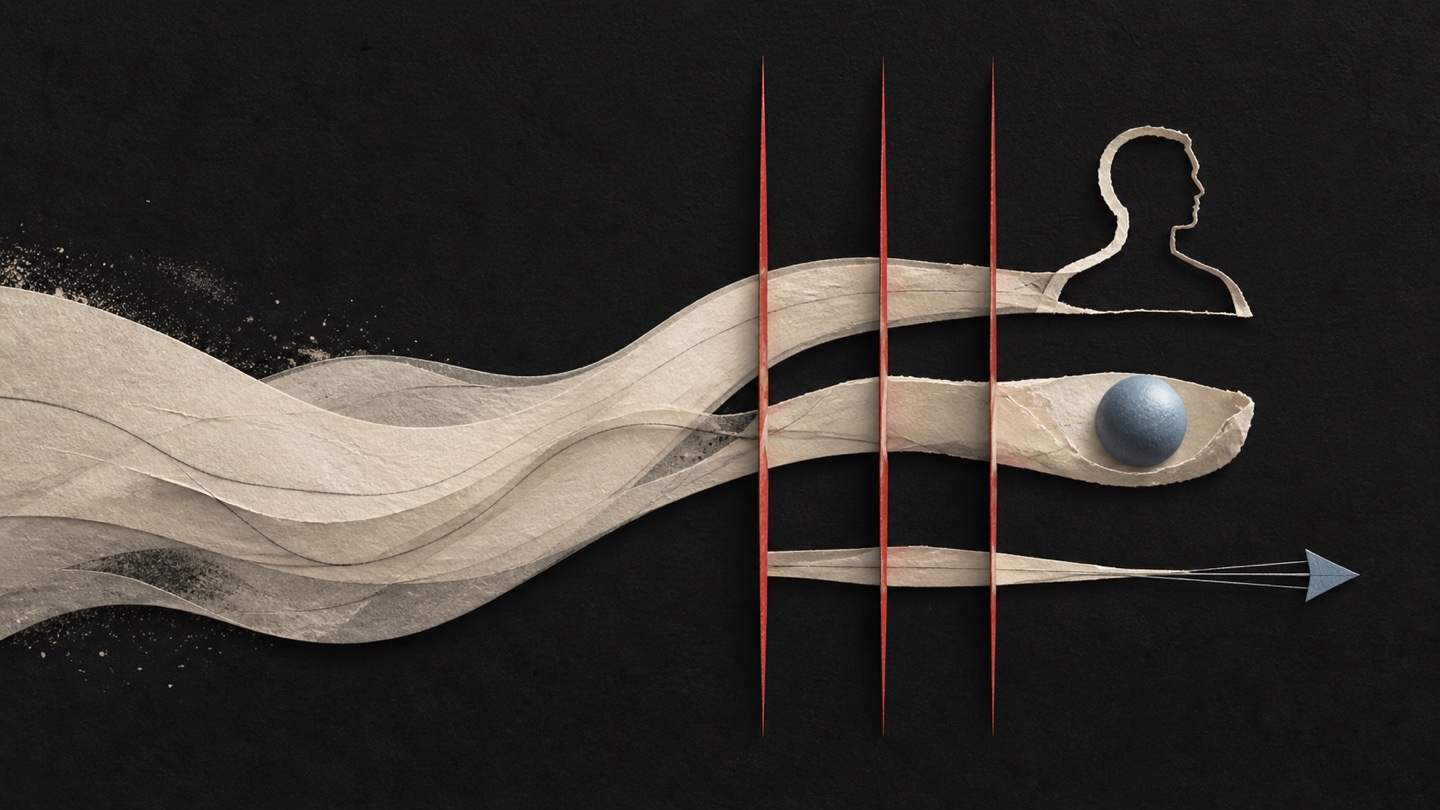
One process enters. English cuts out a watcher, a watched thing, and a relation between them.
Situation
Nearly every meditation instruction you have heard in English is a translation of something composed in Pali, Sanskrit, or an Indian language.
Complication
Languages differ in what they force you to say. English cannot make a sentence without a subject. The source languages can, and constantly do.
Question
Does the English version therefore ask you to do something the original did not ask?
Answer
Yes. It installs an actor, an owner, and a thing acted upon. Two of those additions are forced by English. The rest are the translator's choice, and can be removed.
The short version
English makes you say who did it. Pali and Tamil often don't. So when an old instruction is translated, an extra person appears inside the sentence: a you doing the watching, and a your breath being watched. The original was closer to "breathing happens, and it is known." Nobody was watching anybody.
01
The argument on one page
English translation of a contemplative instruction adds grammatical commitments the source did not make. The additions are countable and most of them are optional.
Premise
Languages differ in what they force, not in what they permit
Anything sayable in Tamil is sayable in English given enough words. But English cannot produce a finite clause without a subject, or a tensed clause without a time. Tamil, Pali and Sanskrit drop both routinely.
Mechanism
Reification runs in discrete steps, and most are optional
Turning assasati into "bring your attention to your breath" takes seven operations. Two are forced by English grammar. Five are decisions. Section 4 counts them and shows what an instruction looks like without the five.
Evidence
MN 2 describes how a self gets manufactured, and its translations manufacture one
The evidence the discourse gives is sixteen questions built on a pronoun Pali did not need, and six views that differ only in case ending. English requires the pronoun and cannot mark the cases. Translating the text reproduces what the text describes.
Test
Two experiments would settle the direction
Comparable effects in psycholinguistics are modest. Section 9 specifies a translation task and a bilingual crossover, either of which can be run in a term.
02
Which words cut the world into which pieces
A grammatical category is a knife with a fixed angle. It cuts one dimension of a situation and ignores the rest. Every language carries some of these knives as compulsory and leaves the others optional. What follows is the working vocabulary for the rest of the page; the icons reappear later as shorthand.
Case study — when the knife is on the other side
The Pirahã and the missionary
A documented case of a text failing to cross into a language whose grammar demanded evidence the text could not supply.
Daniel Everett went to the Brazilian Amazon in 1977 as a missionary. Pirahã marks evidentiality on the verb — suffixes for hearsay, for deduction, and a zero-marking for direct knowledge — so a speaker cannot make an assertion without indicating how they came to know it. Everett also describes a cultural rule he calls the immediacy of experience principle: assertions are restricted to what the speaker witnessed, or what a living person they know witnessed.
He learned the language and translated the Gospel of Mark. Then the questions started.
They asked what Jesus looked like. He said he had never seen him. They asked whether he knew anyone who had. He said no. Their reply, as he reports it: you don't know anyone who has seen him, and you talk about him all the time. They did not want to hear any more.
He played them a recording of Mark in Pirahã. They understood it. They also recognised the Pirahã man whose voice was reading, and pointed out that he had not witnessed any of it either.
The translation had succeeded. What could not be translated was the standard of evidence the text asked them to accept. Everett was having serious doubts by 1982 and had stopped believing by about 1985. He eventually told the Pirahã he no longer believed it either, and reports that they said: now you are like us.
This is not a story about a tribe of atheists — Everett describes them talking readily about spirits, as things they or someone they know encountered. It is a collision between two ways of establishing that something is so. One transmits across millennia by testimony. The other asks who saw it, and marks the answer on the verb.
Two cautions. Everett's linguistic claims about Pirahã, particularly about recursion, are strongly contested by other linguists, and some of his cultural claims are disputed too. The evidential suffixes themselves are not in dispute. And it has been argued that the immediacy of experience principle is not unique to Pirahã at all.
The mirror. Pali and Sanskrit have no grammatical evidentiality either, which puts them on the same side of this as English. But the tradition handles the problem lexically instead: every discourse opens evaṁ me sutaṁ, "thus by me it was heard." That is a hearsay marker, stated once at the top of the text. Pirahã would require one on every verb. English translations render it "Thus have I heard" and it reads as liturgical formula rather than as the evidence claim it is.
03
One situation, eight cuts
The situation: something is wrong, now, with the speaker. Below are eight ways of saying it. The vertical lines are word boundaries. These are not stylistic variants of one underlying sentence. They are different decisions about how many participants exist and what relation each has to the state.
English can suppress the person, but it charges for the service: a placeholder in the subject slot, and the conversion of a state into a noun. Tamil pays neither. That is the technical content of the observation that the English impersonal sounds clinical.
Grammar forces you to specify
Grammar lets you leave open
Experiencer deletion is not a Tamil quirk
Dropping the person entirely from a report of one's own condition is available across South Asia, in both language families. Malayalam is the limiting case: no person, no bearer, no tense, one word.
Language
Form
Word for word
Participants named
Tamil
உடம்பு சரியில்லை
body — right — not
one, and it is a body part
Tamil
மனசு சரியில்லை
mind — right — not
one, and it is the mind
Kannada
ಮೈ ಸರಿ ಇಲ್ಲ
body — right — not
one
Malayalam
സുഖമില്ല
wellness — not
none
Hindi
तबीयत ठीक नहीं
health — right — not
one, an abstract noun
English
I am unwell
—
one, and it is the whole person
Marathi and Bengali pattern the same way. Those forms need a native check before they are printed as evidence.
04
How a process becomes a thing with an owner
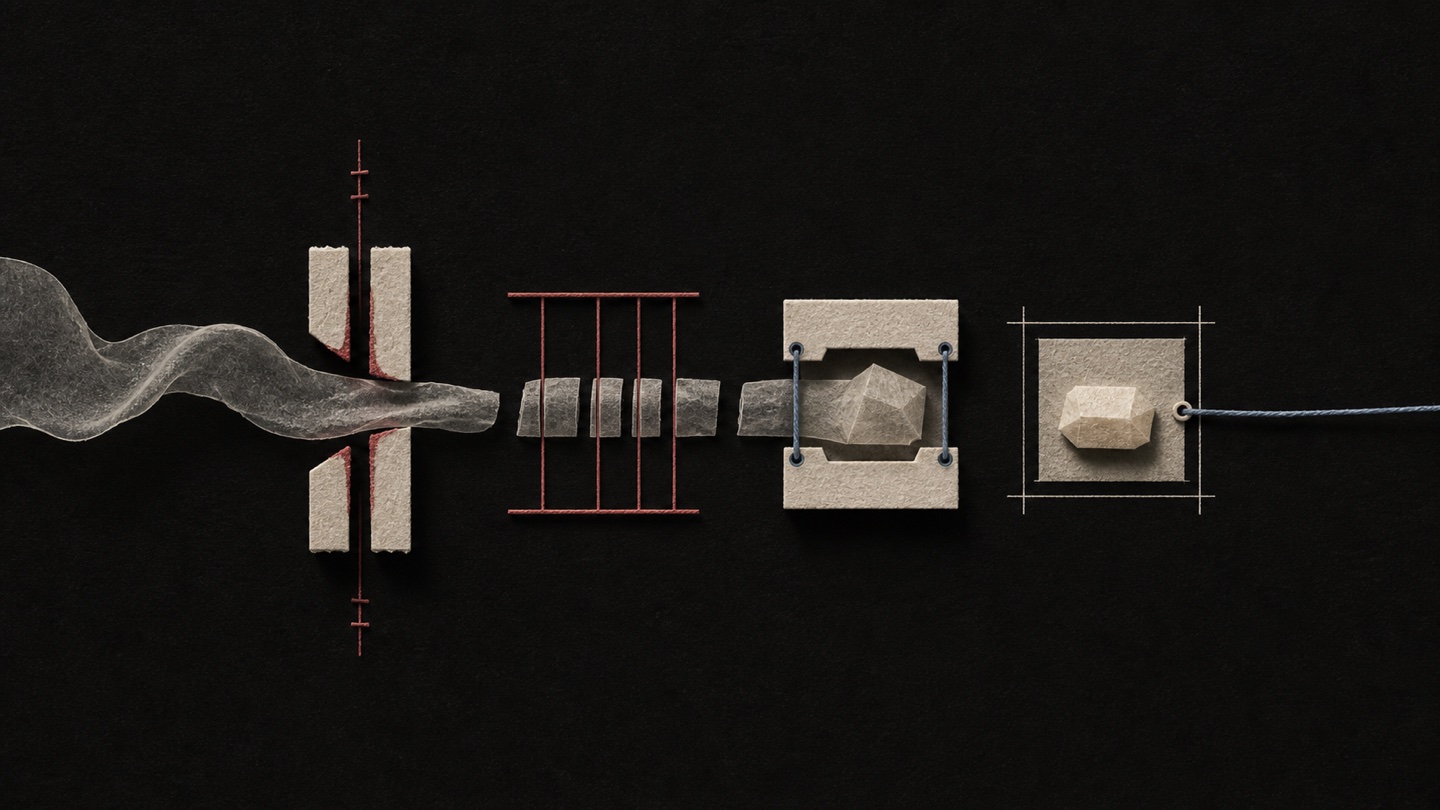
Reification is not one move. It is a sequence of discrete grammatical operations, each applied independently, and each either forced by English or chosen by the translator. Below, the standard breath instruction, one operation at a time.
Process → segment → object → property. Each operation makes the breath easier to own, move, grip and lose.
Entities1
Relations0
Forced0
Chosen0
Operations applied
The three families
Thingifying turns a process into an object: nominalisation, then individuation by article or number. Peopling introduces entities that were not there: an owner, then an agent. Wiring asserts relations between them: transitivity, a path, a copula, a tense anchor.
What removing the optional five actually produces
Both scripts are ordinary English. They differ in what the listener is asked to be.
Standard
Bring your attention to your breath. Notice how your breath feels. When your mind wanders, gently bring your attention back.
Entities: you, your attention, your breath, your mind — 4
Relations: three ownerships, one transport, one return — 5
Asked of the listener: locate a faculty, move it, hold it there, detect failure, repeat
Optional operations removed
Breathing in, and knowing it. Breathing out, and knowing it. When there has been wandering, that is known too, and there is breathing again.
Entities: none nameable — 0
Relations: none asserted — 0
Asked of the listener: nothing is located, moved or held; knowing accompanies breathing rather than acting on it
Does it make a difference? That is exactly what Study 2 tests, and nobody has run it. What is already established without any study is narrower and still useful: the left-hand script asks for five operations that are absent from the Pali and absent from the right-hand script, and every teacher currently choosing between them is choosing without knowing there is a choice.
The practical consequence is that the familiar beginner's complaint — I keep losing it, I can't hold on to the breath — is a report about a task the left-hand script assigns and the right-hand one does not. Gripping and losing are what you get when the instruction has posited a thing, an owner, and a transport operation.
05
MN 2: a discourse about installing a self
The Sabbāsava Sutta is about how the āsavā — the taints, the things that leak — come to an end. It names seven ways they are abandoned: by seeing, by restraint, by use, by endurance, by avoidance, by dispelling, by cultivation. The entire text is built on pahātabbā, "to be abandoned", a gerundive, which is a form with no agent slot in it at all.
This paper uses only the first of the seven, abandoning by seeing. That section is where the discourse describes how a self gets manufactured, and it is the section English translation damages most.
Pali from the Chaṭṭha Saṅgāyana edition. Tamil from நவாலியூர் சோ. நடராசன், on SuttaCentral. English renderings from Bodhi, Sujato, and Words of the Buddha, paraphrased rather than quoted.
The discourse tracks the questions that install a self. Translation can install the figure in the grammar before the reader reaches the diagnosis.
5.1 What "abandoning by seeing" says
The passage is a causal chain, and it runs in both directions. A person who has not been taught does not know what is worth attending to. Attending from the wrong place, sixteen questions arise. Out of those questions, one of six views. Out of the views, what the discourse calls a thicket of views, a wilderness of views, and no release from birth, ageing and death.
Run the other way: a person attends from the source to the four truths, and three fetters fall away. The first of the three is sakkāyadiṭṭhi, identity view — the belief that there is a self here.
The passage is an account of how a self is assembled out of a certain kind of questioning, and of what dismantles it.
5.2 Why those sixteen are the wrong questions
Take the word here. It picks out wherever the speaker happens to be standing. It has no career of its own: it was not somewhere else last year and it will not move tomorrow. "Was here here in the past?" is not a difficult question but a malformed one, because here is a device for indexing an utterance, not a name for a place.
The sixteen questions treat I as though it were a name. Each asks after a property of something across time: whether it existed, what it was, how it was, what it changed into. Those are reasonable questions about Devadatta, who is a person with a history. "Was Devadatta in the past?" and "Was I in the past?" have the same grammatical shape, so the second looks equally answerable. But I is not a name. It picks out whoever is speaking, the way here picks out wherever they are standing. Asking what it was doing before the sentence started is asking after the history of a pointer.
This is why the discourse calls the result a thicket rather than a mistake. A mistake is corrected by finding the right answer. A malformed question generates answers indefinitely, and the six views are where the generating stops: six positions a person settles into after trying to answer something that has a grammatical subject and no semantic one.
A language that obliges its speakers to pronounce that pointer in every clause is a poor vehicle for this diagnosis.
5.3 The pronoun that did not need to be there
Pali, Sanskrit and Tamil are pro-drop languages: the verb ending already identifies the person, so the pronoun can be left unsaid, and normally is. Ahosiṁ means "I was" on its own. English is not pro-drop — it cannot leave the subject slot empty, and inserts a placeholder where there is no participant at all: it is raining, there is a body.
So when ahaṁ, "I", is written in Pali alongside a verb that already carries it, it is doing no grammatical work. It is surplus, and surplus in a pro-drop language is emphasis. It appears in five of the fourteen questions, always at a question about bare existence or about becoming, and never at a "what" or a "how".
Below, the past and present sets. The five future questions repeat the past pattern with bhavissāmi for ahosiṁ, and are omitted to keep the table readable.
pronoun written although the verb ending already carried it pronoun with no counterpart in the Pali
Pali
Tamil — Natarajan
English
ahosiṁ nu kho ahaṁ atītamaddhānaṁ?
நான் முன்னே இருந்தேனா?
Was I in the past?
na nu kho ahosiṁ atītamaddhānaṁ?
நான் முன்னே இருக்கவில்லையா?
Was I not in the past?
kiṁ nu kho ahosiṁ atītamaddhānaṁ?
நான் முன்னே என்னவாயிருந்தேன்?
What was I in the past?
kathaṁ nu kho ahosiṁ atītamaddhānaṁ?
நான் முன்னே எப்படியிருந்தேன்?
How was I in the past?
kiṁ hutvā kiṁ ahosiṁ nu kho ahaṁ atītamaddhānaṁ?
என்னவாயிருந்து முன்னே என்னவாக மாறினேன்?
Having been what, what did I become in the past?
ahaṁ nu khosmi?
நான் இருக்கிறேனா?
Am I?
no nu khosmi?
நான் இல்லையா?
Am I not?
kiṁ nu khosmi?
நான் யார்?
What am I?
kathaṁ nu khosmi?
நான் எவ்வாறிருக்கிறேன்?
How am I?
Across all fourteen questions: Pali writes the pronoun five times. Natarajan's Tamil writes it thirteen times. English writes it fourteen times, because it cannot do otherwise.
The Tamil count is the interesting one. Tamil could have tracked the Pali exactly — it is pro-drop, and dropping the pronoun costs nothing. Natarajan supplies it almost everywhere instead, and the one place he omits it is a place where the Pali has it. His two parallel "having been what" lines disagree with each other, the past dropping நான் and the future keeping it, which indicates the choice was made for flow rather than for the pattern.
This is the forced-and-chosen distinction from section 4, applied to a translator. For English the pronoun is forced. For Tamil it was chosen, and the capacity went unused.
5.4 Three ways the pronoun fails in translation
What happens to a naive English rendering, and what a translator can do about it.
Case
Example
What the naive rendering does
What a translator can do
1. Pali has no pronoun; English adds one
kiṁ nu kho ahosiṁ atītamaddhānaṁ? "What was I in the past?"
The inserted I gives the question a visible subject the Pali did not give it, and makes it look identical in weight to the marked questions. This is where the flattening happens.
Nothing, if the sentence stays a question in the first person. The pronoun can only be avoided by recasting: "What, in the past?" — which reads as elliptical rather than as the ordinary Pali it translates.
2. Pali marks emphasis; English shows no difference
ahaṁ nu khosmi? "Am I?"
English supplies I here for the same reason it supplied one in case 1, so the emphatic and the unemphatic questions come out looking the same. The distinction the text was making disappears without a trace, and the reader has no way to know a distinction was there.
Nothing, using the pronoun alone. Every published rendering leaves this flat, which is not a failure of care — English has no unmarked way to signal that a pronoun is surplus, because in English it never is.
3. Pali marks emphasis; English could show it
ahaṁ nu khosmi? "Do I even exist?" · "Is it I who am?" · "As for me — am I?"
—
English has devices for emphasis that are not the pronoun: a cleft, an intensifier, contrastive italics, a fronted phrase. Using one of them recovers the Pali's marking. That none of the standard translations does so shows the loss in case 2 is a translator's choice rather than a limit of the language.
Case 3 is the practical one. A teacher reading these questions aloud can put the weight where the Pali puts it — on "Am I?" and "Will I be?", and off "what" and "how" — and the passage recovers its shape without a word being changed.
5.5 Views three, four and five are one clause with two slots
A case ending is a suffix on a noun saying what part it plays in the event: the doer, the thing done to, the means, the place. English mostly uses word order and prepositions instead. Pali, Sanskrit and Tamil use endings, which lets them distinguish roles English blurs.
Here are the six, with the grammar shown.
Pali
Grammar
Sense
1
atthi me attā
attā NOM + me GEN
a self exists, and it is mine
2
natthi me attā
attā NOM + me GEN
no self exists for me
3
attanā va attānaṁ sañjānāmi
attā INS + attā ACC
from self, I perceive self
4
attanā va anattānaṁ sañjānāmi
attā INS + anattā ACC
from self, I perceive not-self
5
anattanā va attānaṁ sañjānāmi
anattā INS + attā ACC
from not-self, I perceive self
6
yo me ayaṁ attā vado vedeyyo …
attā NOM, subject of finite verbs
this self of mine speaks, feels, experiences the results of deeds, and is permanent
Six views, three grammatical shapes.
In 1 and 2, attā is in the nominative as the subject of an existential verb, with me in the genitive. A self exists, or fails to, and it is owned. In 6, attā is again nominative, but now as the subject of finite verbs: it speaks, it feels, it experiences the results of good and bad deeds, and it is permanent. Not a thing that exists — a thing that acts. In 3, 4 and 5, attā is not the subject at all. The subject is the unpronounced "I" inside sañjānāmi, and attā has been demoted into the machinery of perceiving.
Those three are one clause with two slots. The first slot takes the instrumental: what the perceiving proceeds from. The second takes the accusative: what gets perceived. Each slot accepts either attā or anattā, and three of the four possible fillings are listed.
Views 3–5 — what the perceiving proceeds from × what is perceived
perceives attā ACC — self is what is seen
perceives anattā ACC — not-self is what is seen
proceeding from attā INS — self is what it comes from
attanā va attānaṁ sañjānāmi
ஆத்மாவினால் ஆத்மாவைக் காண்கிறேன்
View 3. English: "I perceive self with self", or "the self in itself", depending on the translator.
attanā va anattānaṁ sañjānāmi
ஆத்மாவினால் அனாத்மாவைக் காண்கிறேன்
View 4. English: "I perceive not-self with self."
proceeding from anattā INS — not-self is what it comes from
anattanā va attānaṁ sañjānāmi
அனாத்மாவினால் ஆன்மாவைக் காண்கிறேன்
View 5. English: "I perceive self with not-self."
anattanā va anattānaṁ sañjānāmi
Not listed. Why not is discussed below, and the honest answer is that it may not be a question — see 5.6.
Three of four cells are occupied. In Pali and Tamil the three views are as distinct as instrumental and accusative. In English they read as one vague idea, so a practitioner cannot check which of the three they are doing.
5.6 View five, and the cell that is not there
View five is the one worth sitting with. Anattanā va attānaṁ sañjānāmi — proceeding from not-self, perceiving a self. Read quickly it sounds like accomplished practice: someone who has seen through the self and is now observing from that vantage. The discourse lists it as a wrong view.
The reason is in the case ending. The instrumental turns whatever fills that slot into something the perceiving comes from — a standing position. Not-self used as a standing position is no longer functioning as not-self. It has become the place you are looking out from, which is the job a self does. The view is not wrong because not-self is false. It is wrong because the grammar has made it into somewhere to stand.
That is a near-enemy, and it is the kind a practitioner can occupy for years. It is also invisible in English, where "with not-self", "by not-self" and "in what is not-self" all appear in published translations and point at three different things.
This reading of view five follows from the case marking. It is not something the discourse spells out, and the commentary may take a different line — see below.
The missing fourth cell
Anattanā va anattānaṁ sañjānāmi, proceeding from not-self and perceiving not-self, is not in the list. Three explanations, in decreasing order of confidence.
The plainest is that the absence may mean nothing. The six are an enumeration of views that arise, not a matrix someone filled in. That three of them happen to occupy three-quarters of a clean square may be an artefact of our drawing the square. This possibility should be held before the other two, and it is the reason the grid above is presented as an observation rather than as the text's own scheme.
If the list is systematic, the structural explanation is sufficient. All six are views about a self — the passage is describing how sakkāyadiṭṭhi, identity view, gets built. A sentence with no attā anywhere in it is not a view about a self, so it has no business in a list of them. This accounts for the absence without any claim about whether the sentence is true.
A third reading is more speculative and more interesting. The sentence may be close to accurate, and holding it as a position is what spoils it. Sañjānāmi still carries a first-person ending, so somebody is claiming it, and a claim about the absence of a self made by a claimant has smuggled one back in. On this reading the cell is empty for the same reason emptiness is said not to be a view. This is attractive, and the discourse does not say it.
The commentary, Papañcasūdanī, reads views 3–5 in terms of which of the aggregates is taken as self and which as not-self, and would probably settle the question. It has not been checked for this paper.
5.7 The translation ladder
One sentence, five renderings. The Pali is a genitive absolute with a passive verb: the fetters are the grammatical subject, the practitioner sits in the genitive at the edge of the clause, and nobody abandons anything.
Dark segments are commitments present in the Pali. Red segments are commitments added in translation.
Tamil does not win everywhere. Yoniso is an ablative, from yoni, womb or origin: attention from the source. Every English rendering converts it to an adjective of quality — wise, appropriate, radical, rational. So does the Tamil: சாதுரியமான, sāduriyamāṉa, "skilful", from Sanskrit cāturya, dexterity. And Natarajan renders manasi karoti, "does in the mind", as சிந்திக்கிறான், "he thinks", a finite verb with an agent in the ending. Where Tamil does hold the line is in the table below.
Pali
Tamil
English
"there is a self for me"
atthi me attā EXIST + 1SG.DAT
எனக்கு ஆன்மா உண்டு 1SG.DAT + EXIST
"I have a self" — a transitive verb of possession, asserting more than the source
"it is possible for one who knows"
jānato ... vadāmi know.PTCP.GEN
கொள்பவனுக்கே ... ஒழிக்க முடியும் DAT + impersonal potential
needs a relative clause with its own subject
"a view arises at him"
assa ... diṭṭhi uppajjati 3SG.GEN + view.NOM
அவனுக்குப் படும் DAT + intransitive
"they develop a view" in the agentive register; careful translators keep "arises in him"
"this: suffering"
idaṁ dukkhaṁ no copula
இது துக்கம் no copula
"This is suffering" — the copula cannot be omitted
5.8 The gerundive, and what happens when it becomes an instruction
The discourse is built on pahātabbā, a gerundive. A gerundive has no agent slot in the grammar at all — not an omitted agent, an absent one. The seven means are case-marked action nouns, ablative in Pali and instrumental in Tamil, and none of them names a doer either.
Pali — ablative
Tamil — instrumental
Sense
dassanā
அகக்காட்சியால்
from seeing
saṁvarā
தன்னடக்கத்தால்
from restraining
paṭisevanā
பழக்கத்தினால்
from using
adhivāsanā
பொறுமையினால்
from enduring
parivajjanā
தவிர்ப்பதால்
from avoiding
vinodanā
கலையச் செய்வதால்
from dispelling
bhāvanā
பயிற்சியினால்
from cultivating
Written English handles the gerundive well, because the modal passive is also agentless. The slide happens in three steps, as the same content moves from canon to retreat hall.
Pali
āsavā dassanā pahātabbātaints.NOM — from-seeing.ABL — to-be-abandoned.GERUNDIVE No agent exists anywhere in the clause. Seeing is a source, not an action someone performs.
Translated
"These are the taints to be abandoned by seeing." Still agentless. English's modal passive matches the gerundive closely. Nothing has been added.
Taught
"Abandon these by seeing clearly." The imperative requires an addressee. There is now someone whose job it is to abandon, and abandoning has become a task with a success condition.
The third line is where the damage is done, and it is done by a single grammatical operation: converting a gerundive into an imperative. The listener now has a role — abandoner — and will begin monitoring their own performance in it. That monitoring is the ayoniso manasikāra the discourse opens by diagnosing. The sentence delivering the remedy installs the condition.
The fix is available and costs nothing: "these fall away in the seeing."
That sentence assigns one thing. The practitioner sees. The falling away is what follows from seeing, not a second task performed afterwards — dassanā is ablative, a source, and the taints proceed from it. Even the seeing is not grammatically attributed to anyone, since dassanā is an action noun with no agent in it.
"Abandon these by seeing clearly" assigns two things: see, and then abandon. The second acquires a success condition, and a practitioner given a success condition will check whether they are meeting it. That checking is the extra work, and the Pali never asked for it.
06
Which instructions diverge most, and what the divergence costs
Ranked by distance between the English construction and the source.
English instruction
Source
What the added grammar makes the listener do
Bring your attention to your breath
assasati
Locate attention as an object, then transport it and hold it in place. Produces gripping, and turns every lapse into a transport failure. The complaint "I keep losing it" is a report about this assigned task, not about breathing.
Watch your thoughts go by
vitakko uppajjati
Construct a viewing position separate from the thoughts and maintain it. The watcher is itself a thought, so the listener ends up watching the watcher, and reports a receding regress.
Just let go
vossaggapariṇāmī
Find a grip and open it on command. Where no grip is present, listeners manufacture one so as to have something to release. The source has a factor that ripens into relinquishment; nobody performs it.
Notice how you feel
vedanā uppajjati
Constitute oneself as an experiencer, then evaluate. Inserts an appraisal step between the sensation and its being known, which is the step the practice is trying to shorten.
Pay attention wisely
yoniso manasi karoti
Treat attention as a finite currency being spent, which produces effort budgeting and fatigue monitoring. The source asks where attention issues from, not how much of it is being spent.
Observe the body as body
kāye kāyānupassī viharati
Step outside the body to look at it. Kāye is a locative: remain within the body while contemplating. The English converts a dwelling place into a viewed object.
I perceive the self in itself
attanā va attānaṁ sañjānāmi
Nothing added, but the instrument/object contrast is lost, so a practitioner cannot tell which of three distinct errors they are making.
These are to be abandoned by seeing
dassanā pahātabbā
Nothing. The modal passive matches the gerundive. This is the register to imitate.
Divergence is highest for the instructions beginners hear first and lowest for the doctrinal formulas. Any effect is concentrated in early practice.
07
Background: three structural facts
A grammar with no subject
Pāṇini's grammar has no category corresponding to "subject". It has six kārakas: roles defined by their relation to the action, which sits at the centre. The agent is defined at Aṣṭādhyāyī 1.4.54 as svatantraḥ, "the independent one" — a position in an event, assignable to inanimate things, not a substrate.
The category of grammatical subject entered European grammar around the twelfth century as suppositum. Neither Apollonius, nor Priscian, nor Pāṇini, nor the Arab grammarians had it. It is late and local, and English builds every clause around it.
Sanskrit: the action is the centre and six roles radiate from it, each carried by a case ending. Word order is free because the endings, not the positions, say who did what. The agent is one spoke of six.
The middle voice, with an example
Sanskrit marks on the verb itself whether the fruit of an action returns to the one acting. One syllable does it.
Active
यजतिyajati — he sacrifices, and the benefit goes elsewhere
Middle
यजतेyajate — he sacrifices, and the benefit returns to him
English
needs an extra clause to say the difference, and usually omits it
English has no morphological middle. It covers part of the same ground with the anticausative — the door opens, the jaw relaxes — and the rest with reflexives and bare intransitives. The anticausative is the closest match and still differs in three ways. It deletes the initiator instead of merging initiator and endpoint, so the speaker ends up outside the event rather than as its site. It is lexical rather than inflectional, available for relax and soften but not for know, dwell or contemplate, which are the verbs the source texts use. And it cannot be made imperative. Sanskrit forms middle imperatives — yajasva, vartasva — so an instruction can be issued in the middle voice. English instruction has only "relax your jaw", where you act on a part you own, and "let your jaw relax", which adds a permission-granting agent rather than removing one.
One limitation. Pali's middle is largely vestigial, so this argument holds for Sanskrit and Greek and applies only weakly to the Pali of MN 2. The middle-voice case is about the shape of the gap in English, not about a feature the source texts of section 5 were exploiting.
What a lone participant is grouped with
Every language decides how to treat the single participant of an intransitive clause. English groups it with agents: "I sat" patterns with "I broke the vase", so sitting is a kind of doing. Ergative languages group it with patients: "I sat" patterns with "the vase broke", so sitting is a kind of happening, and agency becomes the marked option requiring an extra morpheme. Hindi does this in the perfective — मैंने, "I-ERG" — after which the verb agrees with the object rather than the speaker.
English. "I sat" patterns with "I broke the vase": the lone participant is treated as an agent. Sitting still is grammatically an act.
08
Falsification conditions
The argument in five steps. Languages differ in what they force a speaker to specify. English forces a subject and a tense; Tamil, Pali and Sanskrit do not. Contemplative instructions were composed in languages that do not force these and are received in one that does. The additions are discrete, countable, and mostly optional. MN 2 is the sharpest case because it describes the manufacture of a self and its translations manufacture one.
Four results would show this is false.
No markedness gap. If impersonal framings are no more effortful in English than personal ones, relative to the same comparison in Tamil, the mechanism has no basis.
No differential insertion. If English and Tamil speakers, given the same word-for-word gloss, insert agents at the same rate, there is no transmission channel.
No effect on practice. If changing the grammatical frame while holding content fixed changes nothing in what people report doing, the effect does not reach the level that matters.
Culture rather than language. If the difference appears between language groups but vanishes when the same bilingual is tested in both of their languages, the thesis is wrong as stated. This is the likeliest failure mode, and Study 2 is built around it.
Scope
The claim is about default framing and its cost. It is not that speakers of Indian languages are nearer any attainment, or that English speakers cannot realise non-dual states. The classical argument over a substantial self was conducted in Sanskrit by both sides, so grammar does not settle metaphysics. Predicted effects should be assumed small, on the order of those found in the eyewitness-memory work cited below.
09
Suggested experiments
Study 1
Give people a word-for-word gloss and count what they add
Question
Turning an agentless source into a natural instruction, do English speakers add more actors and owners than Tamil speakers?
Method
Eight short passages from MN 2 and the breath instructions, each presented as an interlinear gloss with word meanings supplied and no grammatical guidance. Participants write a natural instruction in their own language.
Participants
Sixty first-language English speakers, sixty first-language Tamil speakers. No meditation experience required. Online, one sitting.
Measure
Per clause: inserted pronouns, inserted possessives, transitive verbs where the source had an intransitive. Two coders, blind to condition, agreement reported.
Prediction
A gap in insertions per clause. A null result here ends the programme cheaply.
Study 2
Give the same bilingual the same instruction in both their languages
Question
Does the language of instruction change what a practitioner does, with culture, tradition and teacher held constant?
Method
Tamil–English or Kannada–English bilinguals who already practise. One recorded twelve-minute guided sit in each language, matched line by line for content and pacing. Both sits per person, order counterbalanced, a week apart. Each participant is their own control, which is the point of the design.
Participants
Forty, within-subject.
Measure
One open question afterwards: describe what happened. Free text coded blind for observer-and-observed language, possessives, and agentive verbs. A state measure can be added; the free text is primary.
Prediction
The same person describes the same practice differently depending on the language it arrived in.
10
Conclusion
English instruction inserts an actor, an owner, and a thing acted upon into practices whose source texts posit none of the three. The insertions are countable, most are optional, and no teacher currently knows they are choosing.
The tether slackens. The boundary opens. Breathing no longer has to become somebody's object.
Established without further study
English cannot produce a finite clause without a subject or a tensed clause without a time. Tamil, Kannada, Malayalam, Pali and Sanskrit drop both in ordinary registers.
Suppressing the person in English costs an expletive plus a nominalisation. Tamil pays neither, and Malayalam suppresses the bearer as well.
Converting assasati into "bring your attention to your breath" applies seven grammatical operations. Two are forced. Five are not.
MN 2's views three, four and five are one clause with the case endings permuted, and the permutation survives into Tamil but not into English.
The Pali marks ahaṁ as surplus at precisely the questions about bare existence. English requires the pronoun everywhere and cannot make the mark.
Conjecture
That any of this changes what a practitioner does. Study 1 tests whether the insertions differ by language at all. Study 2 tests whether the same person practises differently depending on which of their languages the instruction arrived in. Until one of them runs, the reception claim is unsupported, and the effect should be assumed small if it exists.
For a teacher, this week
Every line on the right is ordinary English. None is archaic or stilted, and that is the test: if it sounds translated, the fix has failed and the standard version is better.
Standard
Same content, fewer commitments
What was dropped
Bring your attention to your breath
Breathing in, and knowing it
a portable faculty, two ownerships, a path
Watch your thoughts
Thoughts arise, and that is known
a watcher, and ownership of thoughts
Let go of the tension
The tension easing
a hand that grips and a decision to open it
Notice how you feel
There is a feeling here — what kind?
an experiencer assembled before the feeling
Relax your jaw
The jaw softening
a part you own and someone who acts on it — though this only shifts you from actor to witness, since English has no imperative for the middle
Abandon these by seeing clearly
These fall away in the seeing
an abandoner with a success condition
Come back to the present moment
This, now
a traveller, a destination, and a return trip
Two cautions. "Let your jaw relax" is not a fix — let is an imperative to an agent who grants permission, which adds a doer rather than removing one. And a whole session in the right-hand register becomes hypnotic and hard to follow; the column is a set of substitutions to reach for at the moments that matter, not a house style.
What the discourse already said
MN 2 opens by listing sixteen questions that arise when a grammatical pronoun is taken to name something, and closes by describing the taints falling away in a clause where nobody does the abandoning. Between those two points it names the disease as the manufacture of a doer. An English translation of it manufactures one, in the sentence that delivers the diagnosis. The instruction and the text have come apart. The gap is made of specific and countable grammatical operations, and most of them are optional.
11
Sources
MN 2 Sabbāsavasutta. Pali and English at wordsofthebuddha.org and SuttaCentral. Tamil translation by நவாலியூர் சோ. நடராசன், SuttaCentral.
Jakobson, R. (1959). On linguistic aspects of translation. Languages differ in what they must convey, not in what they may.
Slobin, D. (1996). Thinking for speaking. The framing of experience for the purpose of putting it into words, which is what a guided instruction imposes from outside.
Verma & Mohanan, eds. (1990). Experiencer Subjects in South Asian Languages. CSLI.
Subbarao, K. V. (2012). South Asian Languages: A Syntactic Typology. Cambridge.
Kemmer, S. (1993). The Middle Voice. Benjamins.
Bhartṛhari, Vākyapadīya. The division of an event into participants as vikalpa, conceptual construction. The oldest version of this argument.
Barthakuria, A. C. The Philosophy of Sanskrit Grammar: A Critical Study of Kāraka.
Anālayo (2003). Satipaṭṭhāna: The Direct Path to Realization.
Collins, S. (1982). Selfless Persons. Cambridge.
Fausey & Boroditsky (2011). Cross-linguistic differences in eyewitness memory. The closest existing experimental paradigm. Read with Liberman's critique of the effect sizes on Language Log.
Nietzsche, Genealogy of Morality I.13. There is no substratum behind the doing; the doer is added to the deed by grammatical habit.
Bohm, D. (1980). Wholeness and the Implicate Order, ch. 2. The rheomode, and its instructive failure.