THE EDGE OF SMALLA field guide to nature’s smallest print

A question with a 2,500-year waiting list

What can’t be divided any more?

Cut a stone in half. Cut the half in half. Give the knife excellent coffee and keep going. Does nature eventually say stop, or is there always another inside?

Meet the old arguments
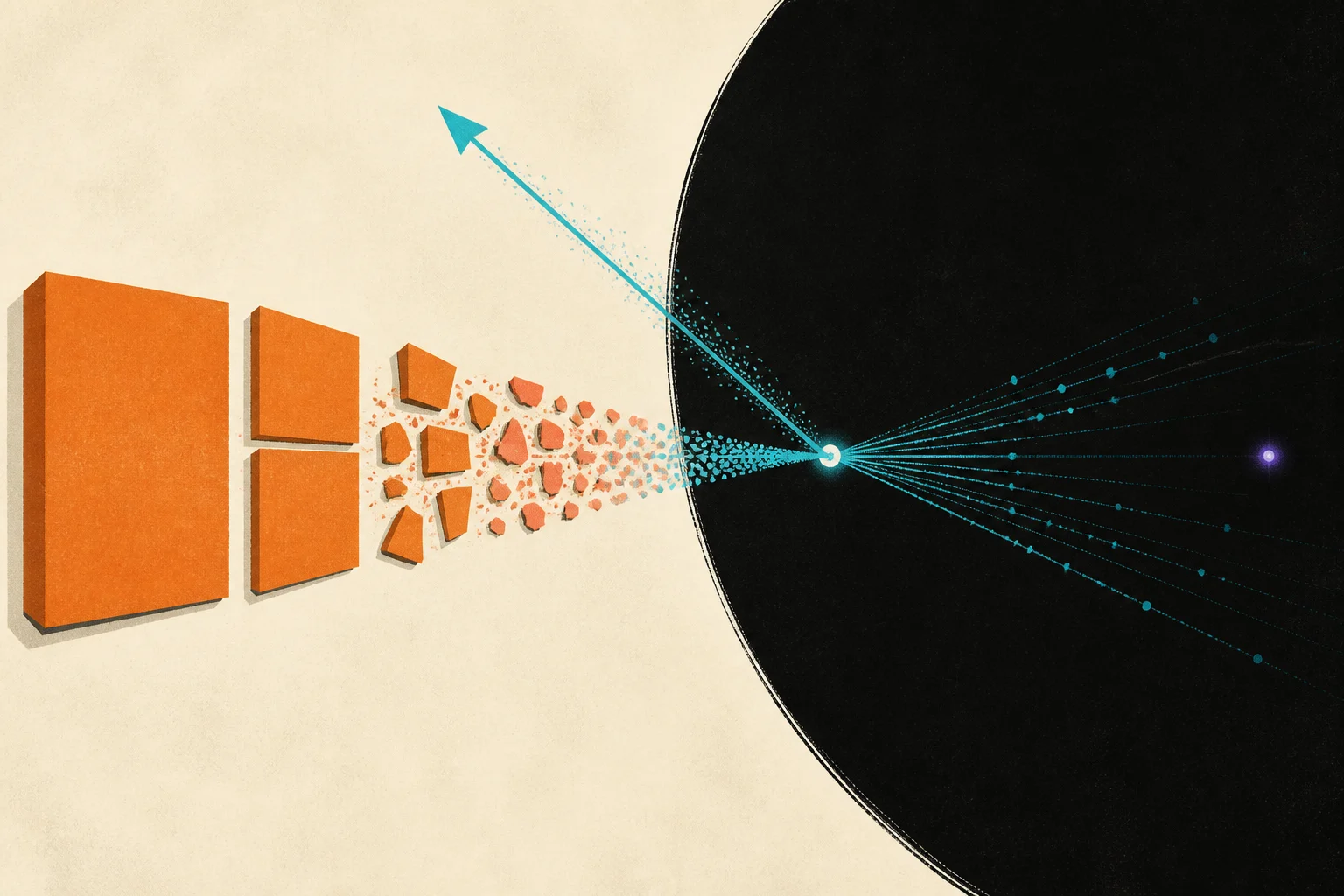
An orange block divides into smaller pieces, becomes a particle beam, and strikes a tiny target; most paths continue and one rebounds into the unknown.
DIVIDE · PROBE · COMPAREWhen the knife becomes useless, throw something smaller.

ACT I · BEFORE THE INSTRUMENTS

Three worlds argued about the bottom.

There was no ancient consensus waiting to be rediscovered. There were rival answers, sharp objections, and no machine capable of deciding among them.

A mountain and mustard seed, a stick repeatedly halved, and pebble-like atoms in empty space represent ancient Indian, Chinese, and Greek arguments about indivisible matter.
Mountain, mustard seed, endless stick, empty space: brilliant arguments, and no experiment to choose among them.
INDIAcenturies before and after 1 CE

The mountain and the mustard seed

Nyāya-Vaiśeṣika thinkers argued that division must end. If a mountain and a mustard seed both contained endlessly many parts, what would make one larger?

Their paramāṇu was invisible and partless. Atoms formed dyads; later commentators described triads as the first compounds large enough to perceive, like dust in a sunbeam.

Jain scale became stranger. An ultimate atom occupied one space-point, yet subtle matter could pack innumerable atoms into the space of one gross atom. Some accounts let an atom cross the universe in a moment.

These were quality-bearing metaphysical atoms, not early quarks.

CHINAWarring States era

The stick that outlives history

A puzzle preserved in the Zhuangzi says: take half of a one-foot stick every day and it will not be exhausted in ten thousand generations.

DAY 0DAY 1DAY 2DAY 3DAY 4DAY 5

Later Mohist texts push the other way. On one contested reading, repeated halving ends in a duān, a located point with no magnitude. Another surviving paradox makes a dimensionless thing span a thousand li. How do sizeless points make a line with size?

The stick is not securely attributable to Hui Shi, and the damaged Mohist text admits more than one reading.

GREECEfifth century BCE

Uncuttable pieces in empty space

Leucippus and Democritus proposed atomos: pieces that could not be cut again, moving through void. Their atoms differed in shape and arrangement.

Chemists later borrowed the word atom. The object carrying the name turned out to contain electrons and a nucleus. The branding survived its first collision with evidence.

Greek atomism was natural philosophy, not an experimental detection.

INDIA · FIFTH CENTURY CE · A CROSS-EXAMINATION

Vasubandhu set a trap for the partless atom.

Put one atom in the middle and neighbours on six sides. If they touch it in six different places, the middle has six parts. If it has no sides at all, the neighbours meet at the same place and the pile gains no size.

He was not predicting modern physics. He was attacking the coherence of material atomism as part of a Buddhist idealist argument. The old question was already misbehaving: perhaps “smallest piece” was not a stable idea.

SIX CONTACTS
Then the centre has parts.
OR
ONE LOCATION
Then the pile has no size.

Philosophy made the question precise. It could not make the target hold still. The knife was the problem, so science changed the verb: stop cutting, start throwing.

ACT II · SEEING WITHOUT LOOKING

Use a projectile as a smaller knife.

Send a known probe towards an unseen target. Record where it goes. Repeat until the target has written a distribution.

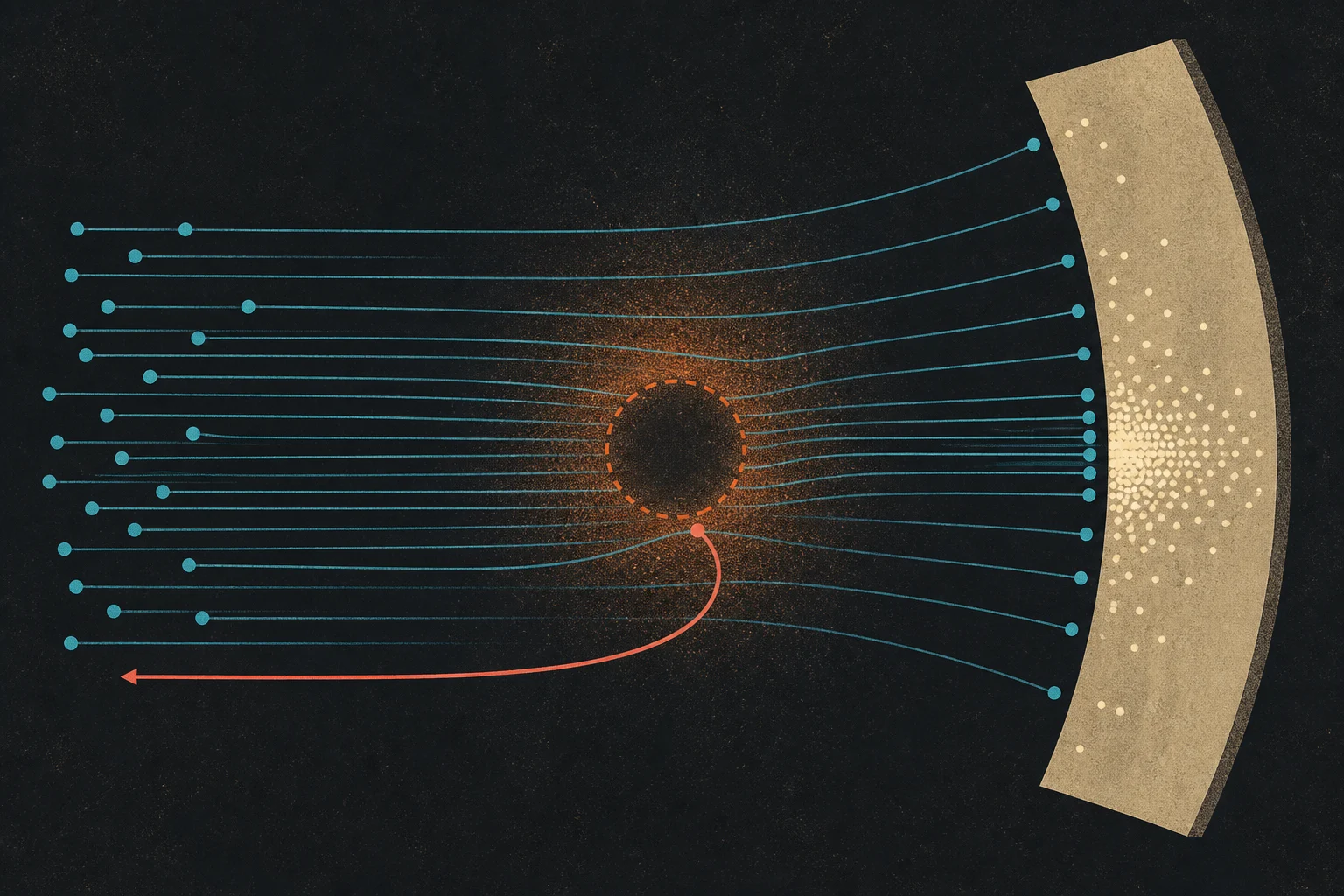
Many cyan projectiles pass an unseen target, some bend, one returns sharply, and a curved detector records where they land.
We never see the target directly. We infer it from where many projectiles land—and from the rare one that comes back.

Mostly straight

The target may be mostly empty at this scale, or the probe may interact only weakly.

A modest bend

The probe felt something spread out, or passed near a source of force.

A sharp return

Something compact delivered a large kick.

This is scattering. The moving dot is the spectacle. The rate, angle, energy, and final products are the evidence.

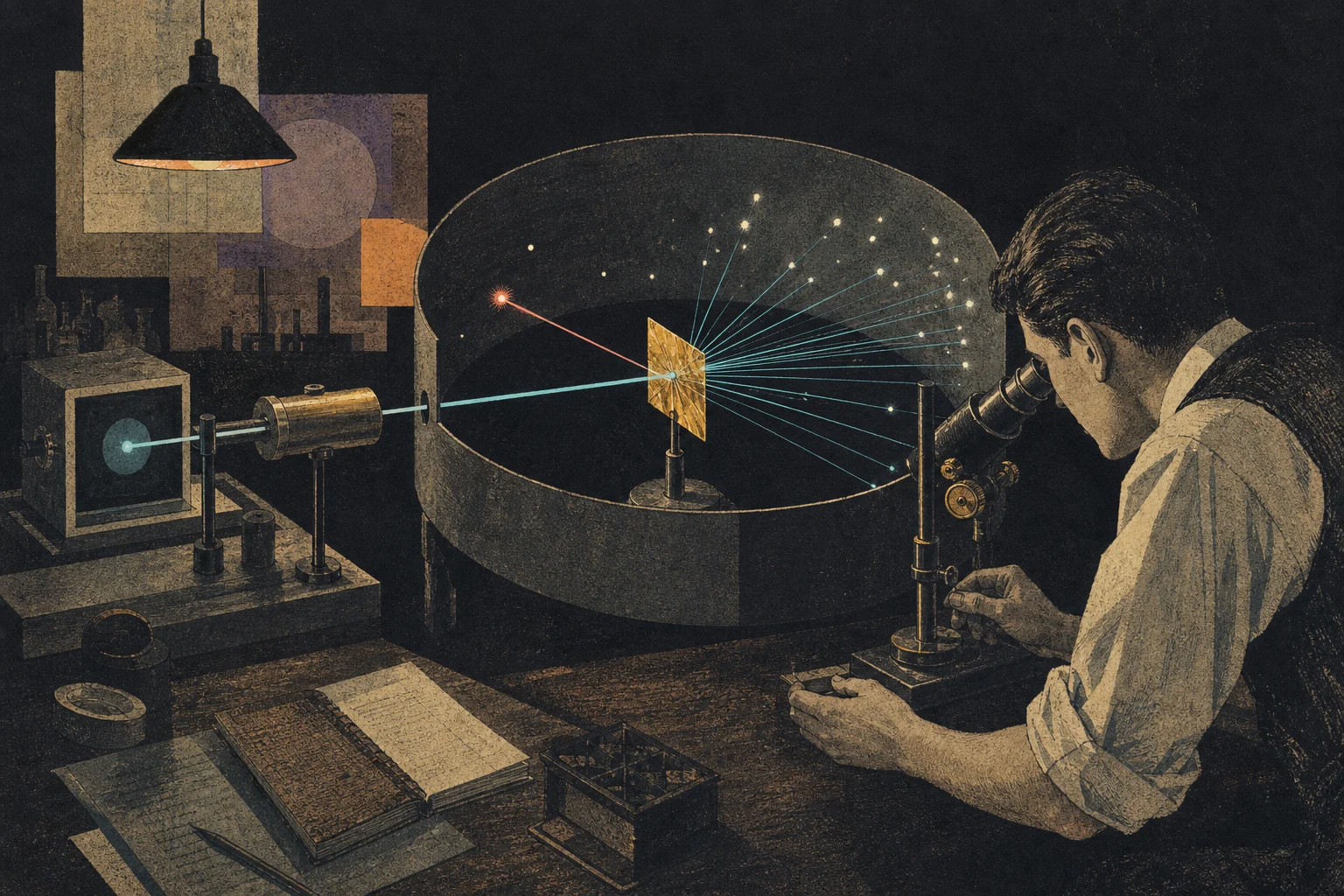
A dark early-twentieth-century laboratory where a researcher watches flashes through a microscope as alpha particles strike thin metal foil.
Each flash marked one alpha particle striking the zinc-sulphide screen.

1909–1913 · MANCHESTER · COUNTING FLASHES

The return that should not have happened

Hans Geiger and Ernest Marsden aimed alpha particles at thin metal and watched a zinc-sulphide screen through a microscope in a dark room. Each tiny flash was one arrival.

Thomson’s model spread positive charge throughout the atom. A heavy alpha particle should collect small nudges and continue roughly forward. Instead, a measurable fraction came back. The 1909 paper estimated about one in 8,000 for platinum.

“It was almost as incredible as if you fired a 15-inch shell at tissue paper—and it came back and hit you.”Rutherford, recalling the result in 1936

The background count mattered. So did the pattern across metals and foil thicknesses. In 1911 Rutherford showed that a compact central charge could produce the large-angle tail. Geiger and Marsden tested the angular law with gold and silver in 1913.

FIGURE 01 · THE REBOUNDThe old atom could not explain the backscatter.Teaching sketch. Angle is direction; distance from the centre is logarithmic rarity.
Log-scale polar comparison of the diffuse-atom expectation with the observed backscatter tailThe diffuse model fades away before the backward half of the chart. The observed curve continues to 180 degrees, where about one alpha particle in 8,000 returned.1 in 101 in 1001 in 1,0001 in 10,0000° FORWARD−90°+90°180° BACK≈ 1 IN 8,000
observed large-angle taildiffuse-atom expectation
The old model’s curve vanished. The particles did not.

The 180° point is anchored to the 1909 platinum result; the rest is a teaching sketch, not reconstructed detector data.

ACT III · TWO PATHS INWARD

One target opened. One kept its secrets.

The nucleus became a chain of discoveries. The electron kept matching the pointlike calculation.

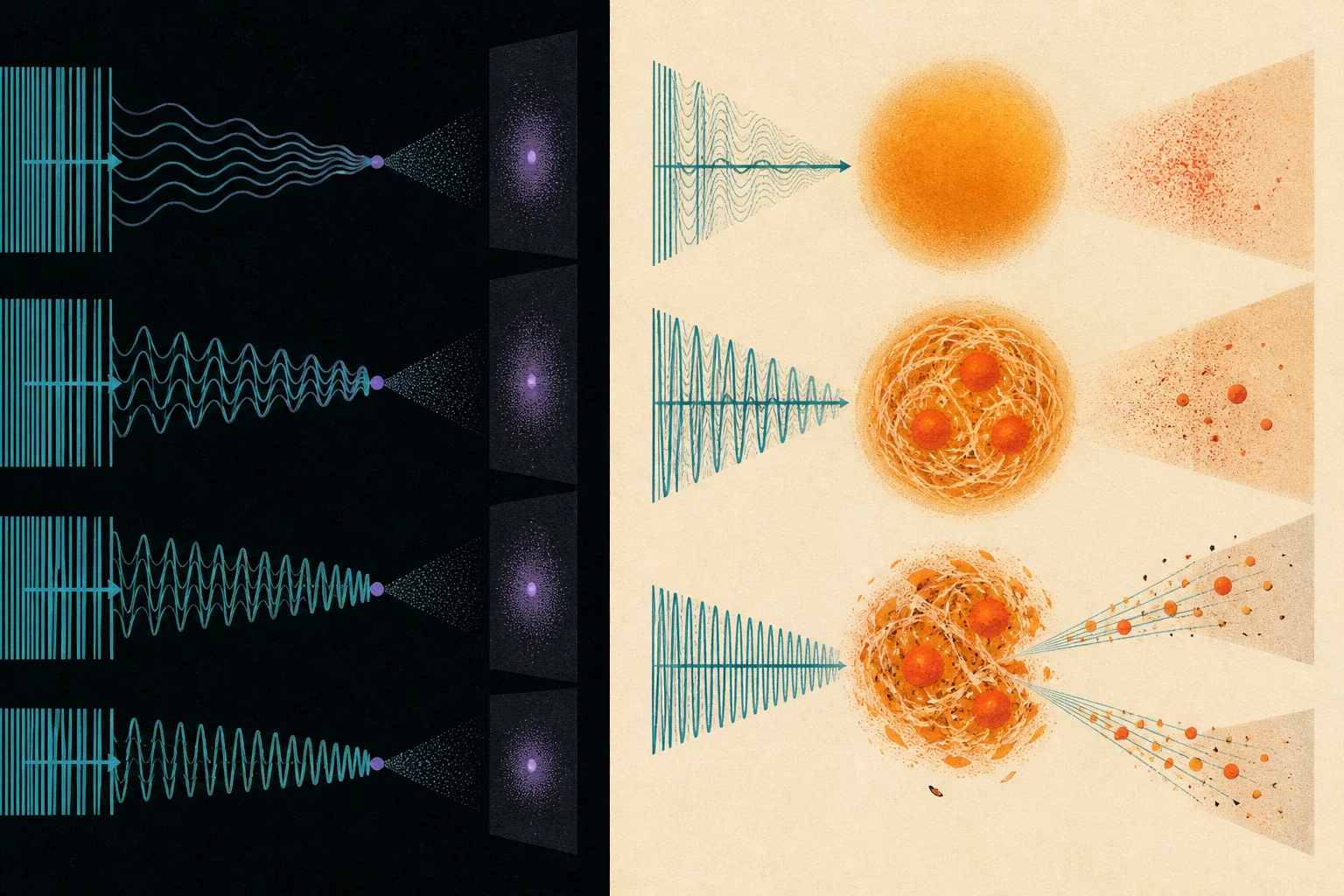
Sharper probes leave the electron as the same violet point, while they reveal a finite proton and eventually make it break into particle jets.
The same interrogation, two answers: the electron remains unresolved; the proton reveals size, internal structure, and breakup.

THE ELECTRON

The dot that stayed a dot

  1. 1897 · J. J. THOMSONCathode rays bent in electric and magnetic fields, revealing a charged constituent far lighter than any atom.
  2. PRECISION AND COLLISIONSElectron scattering, electron–positron collisions, magnetic measurements, and searches for excited electrons keep testing the point model.
  3. RESULT SO FARNo intrinsic radius, form factor from inner structure, breakup pattern, or excited electron has been established.

No structure resolved

THE PROTON

The proton turned out to be a committee

  1. 1933 · FRISCH, ESTERMANN, STERNThe proton’s magnetic moment was about 2.5 times the simplest point-particle expectation, an early clue that its physics was richer.
  2. 1950s · ROBERT HOFSTADTERElastic electron scattering fell below the point-proton prediction. A form factor mapped a finite charge distribution.
  3. 1967–1973 · SLAC–MITDeep-inelastic events stayed unexpectedly abundant. Fast electrons were striking hard partons inside the proton, later identified with quarks and gluons.

Known composite

CLUE 1 · SPACE

Scatter it

A composite target can show a finite form factor, hard centres, or breakup products when the probe becomes sharp enough.

CLUE 2 · ENERGY

Ring it

Internal parts can rearrange. Atoms have spectral lines; protons have resonances. No excited electron has appeared.

ACT IV · YOUR SHIFT AT THE DETECTOR

Can you tell a point from a bag of parts?

Run one experiment and read it three ways: where intact targets scatter, how many stay intact, and whether the target breaks apart. On a desktop, the whole chain of evidence fits in one view.

1 · Choose a target

Larger momentum transfer means shorter wavelength and finer detail.

Smallest detail this probe can test2.7 × 10⁻¹⁶ m

Ten thousand probes reveal the common path and the rare returns.

TEACHING SIMULATION10,000 incoming probes

What this run says: At large angles, fewer protons remain intact than a point-particle calculation predicts. That shortfall reveals the proton’s finite size.

1 · DIRECTIONWhere did intact targets scatter?Full circle, logarithmic scale. Equal changes in bar length mean ten times more or fewer events.
−90°180°+90°
point-particle calculationselected target
2 · INTACT TARGETSHow many stayed intact?This chart divides the simulated intact-target count by the point-particle calculation. Exactly 1 means they agree.
1 · matches a point
10.10.010.001
−165°scattering angle180°

The ratio falls below 1. The missing intact protons are the measurable effect of the proton’s finite size.

3 · EVENT TYPEDid the target break apart?
Pass / forwardSmall deflection
Pass / forward7278Small deflection1607Hard scatter743Hadron spray373

Why jets matter: a quark cannot leave the proton alone. Confinement turns its outgoing energy into a narrow spray of ordinary hadrons. The detector sees that spray—the signature that the proton broke apart—not a free quark.

What is simulated here?

The point curve uses the forward-peaked Rutherford angular form as a teaching scaffold. The proton’s elastic response uses a standard dipole-style form factor; event-type percentages are illustrative. This is deterministic, not detector data or a research Monte Carlo. Its purpose is to expose the logic of prediction, repetition, ratio, and breakup.

ACT V · WHAT “POINTLIKE” MEANS

The Standard Model does not draw tiny marbles.

It describes electrons and quarks as excitations of quantum fields. One electron is a packet in the electron field; every other electron is another packet in that same field. That shared origin is why every electron is exactly identical.

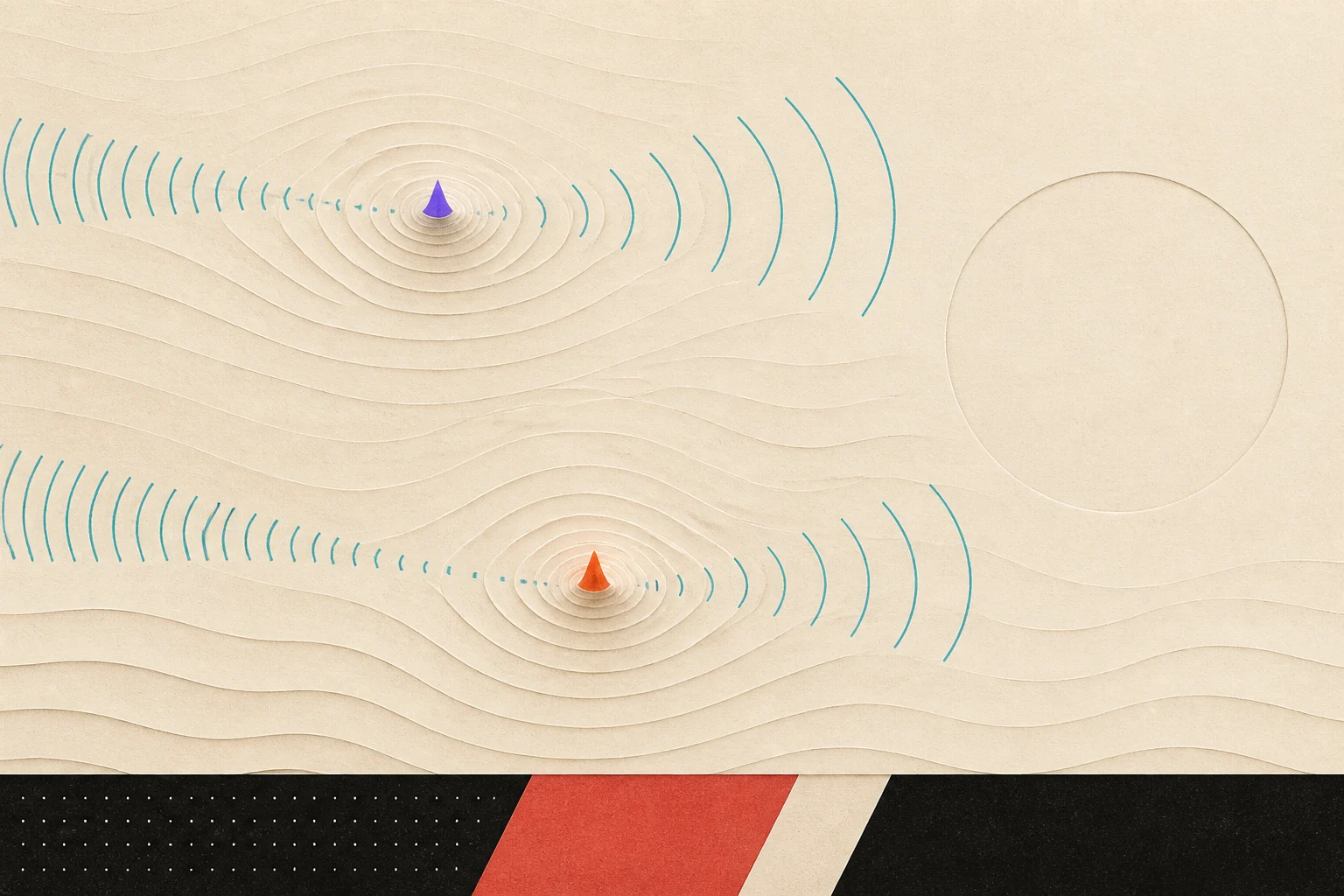
Violet and orange localized disturbances rise from layered fields as clean probe waves cross them; an empty cutaway contains no inner machinery.
In the Standard Model, “particle” means a localized excitation of a field—not a microscopic casing waiting to be unscrewed.

THE CARTOON OF THE TEST

pointlike form factorF(Q²) = 1
then compare
measurement ÷ point predictionR(Q²) ≈ 1

Real calculations include spin, forces, detector effects, and quantum corrections. The simple line isolates the question: does a new Q-dependent structure appear?

The theory makes a prediction we can try to break.

“No inside” is not something a detector can photograph. The Standard Model predicts the collision pattern for a pointlike particle. The experiment then tries to break that prediction.

One field, many identical particles. There is one electron field. There is also an up-quark field, a down-quark field, and one for each other quark flavour. Particles of the same type are identical because they are excitations of the same field—not individually manufactured specks that merely happen to match.

The proton did disagree: fewer intact protons scattered at large angles, its magnetic moment was anomalous, and hard collisions broke it apart. Quark scattering still matches the point-particle calculation down to about 10−20 metres—roughly five orders of magnitude smaller than a proton. No experiment tells us where a deeper layer must begin.

The electron needs different wording.It has no measured radius, so there is no honest “N times smaller than the electron” comparison. Collision and magnetic tests instead constrain specific compositeness models. A 2025 Particle Data Group review reports no excited electron below 5.6 TeV in one standard benchmark; that is a model limit, not a photograph of an electron’s edge.

ACT VI · THE FRONTIER IS A BAND

Fifteen orders of magnitude remain unvisited.

A proton’s charge radius is about 8.4 × 10⁻¹⁶ metres. In a 2026 benchmark analysis, CMS found no quark-compositeness signal around 1 × 10⁻²⁰ metres—about 84,000 times smaller than the proton.

WHERE EXPERIMENTS ARE NOWFor the quark-compositeness test on this page, about 10−20 metres is the current frontier. It is not a universal microscope setting. CMS tested a particular “quarks have parts” model: parts larger than this would have changed the high-energy collision pattern. The pattern did not change, so that version of a composite quark is ruled out.
Compare useful milestonesabout 10⁻²⁰ m
Compared with a protonabout 84,000× smallerCollision momentum needed for this wavelength20 TeV

If the proton were a basketball, this limit would be a bacterium-sized speck, about 3 micrometres across.

This is the momentum one collision must deliver to inspect that scale. A proton collider needs more total beam energy because only part of each proton participates in the hard collision.

FIGURE 02 · THE FIFTEEN-ORDER ABYSSOur map runs out here.Logarithmic length scale. Each equal step is another factor of ten.
8.4 × 10⁻¹⁶ mproton radius
measured size
~10⁻²⁰ mquark compositeness
model-dependent band
15 orders of magnitudeno collider has directly resolved this intervalpossible string scale?
not fixed
1.6 × 10⁻³⁵ mPlanck length
a scale, not a wall
?

Proton → current quark limitIf the proton were Earth, the limit would be about 150 metres across—a large stadium. If the proton were a basketball, the limit would be about 3 micrometres—a bacterium.

Current limit → Planck scaleIf today’s limit were Earth, the Planck length would be about 20 nanometres—roughly protein-sized.

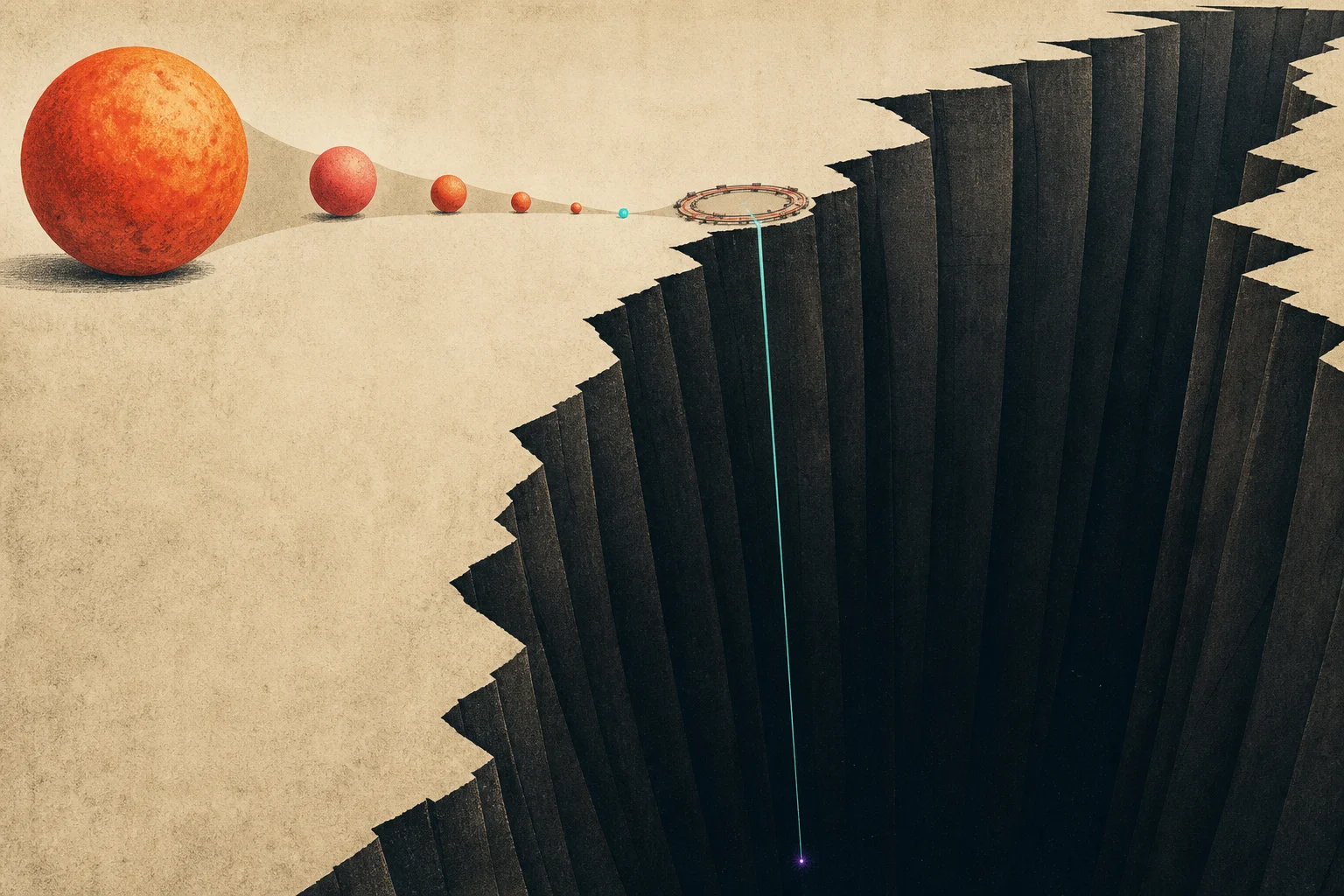
A proton shrinks through five scale steps to the current collider frontier, after which a vast dark canyon descends to a tiny violet point representing the remote Planck scale.
Five orders took us from the proton to today’s quark limit. The Planck scale sits another fifteen orders down—and may not be where compositeness lives at all.
JOB 1 · RESOLVE

Shorten the ruler

More momentum transfer means a shorter effective wavelength: detail ≈ ℏc ÷ Q.

JOB 2 · CREATE

Pay the mass bill

Through E = mc², collision energy can create a heavy constituent or an excited version of the particle.

JOB 3 · REPEAT

Catch the rare event

More collisions shrink uncertainty and expose effects that appear only once in a vast sample.

THREE MACHINES · THREE SEARCHES

Each machine attacks a different clue.

MORE COLLISIONS

High-Luminosity LHC

LOOK FOR: rare excited particles and tiny distortions in the highest-energy events

From around 2030, it will deliver about ten times the LHC’s original design data. That turns rare processes and subtle changes in jet and lepton angles into measurable samples.

CLEANER COLLISIONS

FCC-ee

LOOK FOR: minute errors in how electrons, Higgs bosons, Z bosons, and top quarks behave

The proposed 91 km electron–positron collider would make the starting collision precisely known. Tiny departures from the Standard Model could reveal new physics too heavy to create directly.

MORE ENERGY

FCC-hh

LOOK FOR: heavier constituents, excited quarks or leptons, and shorter-distance contact interactions

A later proton collider in the same tunnel could reach 100 TeV. Its harder collisions would push the direct search for new particles and quark substructure far beyond the LHC.

Two other routes: a muon collider aims to combine a lepton collider’s clean starting point with very high energy; the central challenge is making, cooling, and colliding muons before they decay. Plasma wakefields attack the machine’s physical length by creating enormous accelerating gradients; the next job is producing beams precise enough for a discovery collider.

THE CURRENT EXPERIMENTAL VERDICT

No smaller machinery has shown up.

Proton

Size, resonances, breakup

Electron

No structure resolved

Quarks

No structure resolved

?Below the frontier

Not yet tested

The proton exposed a radius, a ladder of excited states, and debris from its contents. The electron and quarks have exposed none. Across every scale we can reach, the point-particle prediction wins. That is what elementary means in physics: no smaller machinery is needed to explain any result. The next experiment gets one job—break that claim.

THE QUESTIONS THAT REMAIN

Frequently asked questions

What does “elementary particle” mean?

It means that the particle is represented without smaller ingredients in our best theory, and experiments have not forced us to add any. For an electron or quark, physicists have found no measured radius, breakup products, size-dependent loss of elastic events, or tower of excited versions. That is strong evidence over a tested range, not a proof about every possible scale.

Does quantum mean elementary?

No. Quantum describes the rules a system follows. Atoms, nuclei, and protons are quantum systems with components. An elementary particle is one that our best model does not build from smaller ingredients and that experiments have not resolved into parts.

Where does the Standard Model’s mathematics enter?

The Standard Model says what a pointlike electron or quark should do in a collision. Physicists calculate that pattern, include the known quantum effects, and compare it with the detector. If the measured pattern bends away in the same way again and again, the pointlike model has failed—and something new is there.

Why do excited states reveal components?

Parts can rearrange, rotate, or vibrate, which creates a ladder of energies. Atoms have spectral lines; protons have heavier resonances. No excited electron or excited quark has been established. Collisions look for structure in space; excited-state searches listen for the same structure in energy.

How are size, mass, and collision energy connected?

Momentum transfer sets spatial resolution: more Q means a shorter effective wavelength. Collision energy has a second job. Through E = mc², it can create a heavy new constituent or an excited version of a particle. A machine needs enough energy, enough useful momentum transfer, and enough collisions to see a rare effect.

How much farther must experiments go before we know for sure?

There is no finish line supplied by theory. New structure could begin just below the present quark benchmark near 10⁻²⁰ metres, many orders farther down, or never appear as another layer of smaller objects. The Planck length is about fifteen orders beyond that benchmark, but it is a quantum-gravity scale, not a prediction for the size of an electron or quark.

Where would string theory fit?

String theory replaces point particles with tiny extended strings in a proposed quantum theory that includes gravity. Its characteristic string scale is not fixed by the idea alone. It is often placed near the Planck scale, but some models put it much lower. No experiment has confirmed strings, so they belong in the map of possibilities, not in the list of discovered layers.

Is the Planck length the smallest possible length?

We do not know. The Planck length, about 1.616255 × 10⁻³⁵ metres, is built from gravity, quantum mechanics, and relativity. It marks a scale where our present descriptions are expected to need quantum gravity. It has not been measured as a pixel of space or proved to be a minimum length.

Are all electrons really identical?

Yes. In quantum field theory, every electron is a packet of excitation in the same electron field, which exists throughout the Universe. That is why one electron has exactly the same charge, mass, and spin as every other electron.

Is there a separate field for every kind of quark?

In the useful simplified picture, yes. There is an up-quark field, a down-quark field, and fields for strange, charm, bottom, and top quarks. An up quark in a proton and an up quark made in a collider are excitations of the same up-quark field.

Do quantum fields fill empty space?

The fields exist everywhere, even where no particle is present. A particle appears when a field carries a countable packet of energy and momentum. Empty space is the fields in their lowest-energy state, not a box with the fields removed.

What does “pointlike” actually mean?

It means every experiment so far is explained without giving the particle a measurable radius or internal arrangement. It does not mean scientists saw an infinitely tiny dot. It means no collision has resolved an edge or an inside.

Why can’t we look at an electron with a microscope?

Visible light has a wavelength enormously larger than an electron’s tested scale, so it cannot reveal such detail. Particle colliders use much shorter quantum wavelengths: they replace a glass lens with a beam, a detector, and a great deal of counting.

Why do quarks make jets instead of flying out alone?

The strong force does not let an isolated quark escape. As a quark pulls away, its energy creates new quark–antiquark pairs, which become a narrow spray of ordinary particles. That spray is a jet, and it is how detectors see the direction of the original quark or gluon.

Why fire 10,000 probes instead of one?

One hit tells you one thing happened. Ten thousand hits reveal how often each angle and event type occurs—including a Rutherford-style event that may appear only about once in 8,000 tries. Structure lives in the pattern, not in one lucky flash.

Is 10⁻²⁰ metres the smallest distance scientists can see?

For the quark-compositeness benchmark used on this page, about 10⁻²⁰ metres is the present frontier. It is not a universal camera pixel. Different experiments test different effects, and the quoted length depends on the particular model being challenged.

Could electrons or quarks still contain smaller parts?

Yes—but any such parts must hide below the scales already tested, or interact too weakly to have changed the measurements. A successful smaller-parts theory must also reproduce everything the pointlike Standard Model already gets right.

What would prove that an electron has parts?

A repeatable size-dependent change in scattering, electron breakup, or an excited electron would do it. The strongest case would be several clues agreeing on the same new scale, just as radius, resonances, and breakup all agree that the proton is composite.